Showing posts with label Atlanta Blues. Show all posts

Saturday, 21 September 2013

An Interview With Author Robert Lamb

Author Robert Lamb stops by today to chat...


An Interview with Robert Lamb


Why don't you begin by sharing a bit about yourself? 

Born in South Carolina, I grew up in Georgia, graduated from the University of Georgia, worked first in journalism, and then went into college teaching, mainly creative writing, at the University of South Carolina. I'm married and have four children. I now write full-time and I also review books for the New York Journal of Books.


You've recently finished a novella and a new novel. Care to share a bit about these new books? 

The short one, titled And Tell Tchaikovsky the News, is about the redemptive powers of rock 'n' roll. The other one, Journey's End, is about the corrosive effects of suicide on a woman's child and husband. 


You've previously written several books and short stories. Do you find an overriding or common theme or any recurring motifs that infuses your writing?  

Yes. I didn't see it at first in my writing career, but the main recurring theme in what I write is loss: loss of innocence, loss of a loved one, loss of faith, loss of hope, etc.             

With a long repertoire of books, such as Atlanta Blues, A Majority of OneStriking Out,  and Six of One, Half Dozen of Another, how do you think your writing has evolved from one book to the next? 

I don't see that kind of continuity in my writing -- that is, I don't see the evolution of a familiar writing voice moving from one novel to the next. Put it this way: I have four sons; each is different from the others though all came from the same father. Same with the novels I've written. Each novel seems to be its own entity, to have its own story to tell; finding the right voice to tell that story -- or, rather, finding the voice inside me that wants most to tell that story -- is a big challenge. An example: My first novel was a coming-of-age story. The protagonist was age 17; I wrote it in my 40s. Believe me, it took me a while to find, or rediscover, that teenage voice to tell that story.

   
Having written both novels and short stories, do you have a preference for one form above the other, or do they both have equal merits? 

As both a writer and reader, I much prefer the greater range of the novel form, but I do like both. As to merit, however, I find both forms equally demanding, each in its own way. I can tell you this: a short story isn't short simply because it's not long. In other words, a successful short story is not the result of the author's not having the time to stretch it out to novel length; it is, rather, that it is complete in its short form. To go on would spoil it. 


 Is there anything about the process of writing you find particularly challenging? 

No, except perhaps this: I knew how to write long before I knew how to write a novel. As with any craft, know-how is very helpful. A simple tip like "Start your story with the day that was different, the day after which nothing was ever the same again" came as a complete (and liberating) surprise to me. So how smart was that? I might add that I've never had writer's block. When I've got a story going, I can't wait to get to it each day. 


What first sparked your interest in a career as a writer? 

I can trace my love of stories to hearing them read at my mother's knee. As to writing my own stories, I believe I'm simply following a natural bent, a facility with language. I said again and again to my students, "Man is the speech animal, and each of is as different from each other as fingerprints, as individual as snowflakes. Each of us has a unique voice. Find yours. Use it." 


Who are some of your favorite authors? Some of your favorite books? 

I admire many writersranging from Shakespeare to Jane Austen to Hemingway to Tennessee Williams, but Thomas Hardy is my favorite author and W. Somerset Maugham my favorite storyteller.


What’s next on your horizons? 

I'd like to try my hand at writing a screenplay. Now there's a difficult art form!


You can check out more on Robert Lamb at his website: http://boblamb.wordpress.com/


Monday, 19 December 2011

Interview with author Robert Lamb

Today the blog is going from geek to chic, with a visit from literary author Robert Lamb as he chats about his books and writing...


Interview with Robert Lamb


1. Why don’t you begin by sharing a bit about yourself and your writing?

I teach writing and American literature at the University of South Carolina, to which I came after a 20-year career in journalism, last with The Atlanta Constitution. I joined USC as a publications writer/editor, but was invited to teach after my first novel (Striking Out) was published and was nominated for the PEN/Hemingway Award. Been teaching ever since as an adjunct professor. I've been writing fiction since I was 10 years old, beginning when I was inspired by the movie "Gentlemen's Agreement," starring Gregory Peck as a magazine writer doing undercover expose on anti-semitism.


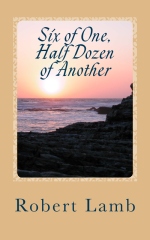
2. Would you please describe your latest books, A Majority of One and Six of One, Half Dozen of Another (Stories & Poems +1), for the readers?

A Majority of One is about a clash between religion and the Constitution. A high school English teacher in a small Southern town gets into trouble when she resists the efforts of local preachers to ban some classic American novels from the classroom. Six of One, Half Dozen of Another contains stories and poems from a lifetime of writing, with an afterword on the origins of the pieces. Over the years, I've much enjoyed reading what authors said about their works and about writing in general. W. Somerset Maugham, among the best of storytellers, had a great deal to say about his works. Stephen King is the only modern writer I know who does it, but the Paris Review's author interviews are well-known for such discussions.


3. You’ve written several books and stories, some of which have nominated for awards. Is there any accolade that you find particularly memorable? Do you have a favourite among your books?

With my first novel, I had the same agent as Pat Conroy, Julian Bach. When Mr. Bach called me one day and said, "I loved your novel; it is a marvelous tale wondrously wrought," I nearly swooned. (In retrospect, though I believe that Striking Out was a very good first novel, I don't think it was that good; still that phone call meant a lot to me.) Among other accolades, I'm proud of being a winner of the South Carolina Fiction Project and of being named to the South Carolina Literary Map. But most of all, I like comments from readers -- the phone call or email from out of the blue that says, in effect, "Your work really moved me." As to a favorite among my books, I don't have one. Besides, one's books are in a way like one's children; even if you have a favorite child, it's unwise to let it be known. Your readers might find this interesting, though: when I reflect on what I've written, I think mostly in terms of scenes I've written, rather than complete stories or novels. I'm a tough critic of my writing, but here and there I've turned out a scene about which I was pleased to think: I can't write any better than that. That's particularly gratifying when I think of the scene here or there that I just never got right in spite of many rewrites.


4. As well as fiction, you also write non-fiction and poetry. Do you find it difficult to switch between these types of writing? And is there a different mindset for you when switching between them?

Perhaps oddly, I don't find writing fiction to require a very different mindset from non-fiction. In each, I'm trying to get it right, trying to make language do what I want it to do, which, among other things, is not only to be understood, but to be so clear that it can't be misunderstood. Poetry is a different animal altogether, too. After "teaching" poetry courses a few times, I concluded that poetry couldn't be taught, that I could only hold classes in it. Writing poetry is for me equally recondite. I rarely see a poem of mine coming, and even after it gets here I rarely know where it came from.


5. Do you have a particular process or a writing routine?

Besides the three novels I've published, I've written two others and am in the homestretch on the sixth. For my first published novel, I wrote every day from 8 a.m. to noon. I haven't been that disciplined on the others, but by nature I'm the kind of person who persists until a job is finished. For aspiring writers who read this, however, I recommend a book titled Structuring Your Novel, by Meredith and Fitzpatrick. It helped me enormously the first time around.


6. Why did you gravitate to writing in a more literary manner as opposed to choosing a niche genre such as mystery or science fiction?

Genres like mystery and science fiction are generally intended as diversionary reading, entertainment. The literary genre concerns itself with what is called the Human Condition: birth, youth, adolescence, courtship, marriage, procreation, old age, death – in other words, the real stuff of life. The two forms sometimes overlap, of course; The Wizard of Oz, though fantasy, obviously was written with a purpose more serious than merely entertainment. Same for Animal Farm. And for Fahrenheit 451 and for 1984. I've had a lifelong interest in human behavior and I've pursued a lifelong quest for meaning and understanding; these interests incline me toward serious fiction, though "serious" should not be construed as omitting humor. I guess basically I want to learn rather than be entertained – but since I enjoy learning I guess you could say I'm entertained by it. Bottom line: different strokes for different folks (but I've actually considered advertising my work as "guaranteed vampire-free.")


7. Are there any authors that profoundly influenced the way you write?

Who knows where influence begins and leaves off? But I'm conscious of trying only to get the best out of myself, which precludes imitating others. We learn from all, however, and I particularly like Hemingway's style, Maugham's storytelling, Hardy's novels.


8. You are also a book reviewer. Do you find being a writer gives you a helpful perspective in reviewing or makes it harder to be objective?

It definitely helps. The old adage "walk a mile in my shoes" comes in very handy in appraising, say, the adroitness of something that another writer has written. Having done both also gives me a heightened awareness, I think, of what another writer was trying to achieve. As an author, I've been positively floored by how bad a reviewer can be, and the badness is almost always rooted in ignorance and/or poor understanding of the craft of writing. I'd be tempted to vote for a law requiring all reviewers to have written at least 100 pages of their own work. A writer whose reviewer reviews the novel the writer actually wrote, instead of what the reviewer thinks he wrote, is a lucky author.


9. Do you have any upcoming projects?

Yes. In the spring I'll being out either of two novels: one that's finished or the one that's nearly finished. Then I will begin rewriting my very first novel, the one that wasn't good enough to find a publisher the first time around.

For more about Robert, you can visit his blog: http://bit.ly/rpQqht

And you can check out Robert's books here:

A Majority of One: A clash between religion and the Constitution in a small Southern town
http://amzn.to/tzBNcI

Six of One, Half Dozen of Another: Award-winning and groundbreaking short stories and poems
http://amzn.to/u4NEoo

Atlanta Blues: A reporter and two cops search for a missing coed; the search leads through the underbelly of urban Atlanta to murder and heartbreak
http://amzn.to/tx6NfY

Striking Out: A coming-of-age novel
http://amzn.to/t3sqU2

Ghosts: A longish short story about a teenage ghost hunt
http://bit.ly/oAIexY

Subscribe Now:

Search This Blog

Powered By Blogger

Monthly Pageviews