Showing posts with label noir. Show all posts

Sunday, 3 September 2017

Book Spotlight: Addict (The Cassie Tam Files #1)

Today I have a book spotlight, for the cyberpunk/crime noir novel Addict (The Cassie Tam Files #1) by Matt Doyle. Plus, there's an excerpt from the book. Enjoy!


Addict (The Cassie Tam Files #1) by Matt Doyle


New Hopeland was built to be the centre of the technological age, but like everywhere else, it has its dark side. Assassins, drug dealers and crooked businessmen form a vital part of the city’s make-up, and sometimes, the police are in too deep themselves to be effective. But hey, there are always other options …
For P.I. Cassie Tam, business has been slow. So, when she’s hired to investigate the death of a local VR addict named Eddie Redwood, she thinks it’ll be easy money. All she has to do is prove to the deceased’s sister Lori that the local P.D. were right to call it an accidental overdose. The more she digs though, the more things don’t seem to sit right, and soon, Cassie finds herself knee deep in a murder investigation. But that’s just the start of her problems.
When the case forces Cassie to make contact with her drug dealing ex-girlfriend, Charlie Goldman, she’s left with a whole lot of long buried personal issues to deal with. Then there’s her client. Lori Redwood is a Tech Shifter, someone who uses a metal exoskeleton to roleplay as an animal. Cassie isn’t one to judge, but the Tech Shifting community has always left her a bit nervous. That wouldn’t be a problem if Lori wasn’t fast becoming the first person that she’s been genuinely attracted to since splitting with Charlie. Oh, and then there’s the small matter of the police wanting her to back off the case.
Easy money, huh? Yeah, right.


Addict is available at these sites:


Excerpt from Addict


I always did like Venetian blinds. There’s something quaint about them in a retro-tacky kinda way. Plus, they’re pretty useful for sneaking a peek out the front of the building if I feel the need. That’s something that you just can’t do with the solid, immovable metal slats that come as a standard in buildings these days. That said, a thick sheet of steel is gonna offer you a damn sight more security than thin, bendable vinyl, so I keep mine installed. Just in case.
Another round of knocking rattles the front door, louder this time than the one that woke me.
The clock says 23:47, and the unfamiliar low-end car out front screams “Don’t notice me, I’m not worth your time,” which makes for the perfect combo to stir up the paranoia that the evening’s beer and horror-film session left behind. This is my own fault. My adverts are pretty descriptive in terms of telling what I do: lost pets, cheating partners, theft, protection, retrieval of people and items, other odds and sods that the city’s finest won’t touch…I’ve got ways to deal with it all. That’s right, I’m a real odd-job gal. The one thing that I don’t put in there are business hours. The way I see it, even the missing pet cases usually leave me wandering the streets at half-past reasonable, so what’s the point in asking people to call between certain hours?
More knocking, followed this time by the squeak of my letter box and a voice. “Hello? Cassandra Tam?”
It’s funny, really. For all the tech advances that the world has made, no one has been able to improve upon the simple open-and-shut letter box. I stumble my way through the dark and wave dismissively at the frosted glass. The light switch and the keypad for the door lock are conveniently placed right next to each other on the wall to the right of the door, sowelcoming my apparent guest is a nice, easy affair. The lock clicks a moment after the lights flood the room, and I pull the door open.
“Cassie,” I say, turning and skulking my way back into the room. “Or Caz. Drop the Tam.”
I hear a sniff behind me, and the lady from the letter box asks, “Are you drunk?”
“If I pass out in the next five minutes, then yes,” I reply, turning the kettle on. I’d left it full, ready for the morning, but I guess this is close enough. “Take a seat at the table. Would you prefer tea or coffee? I’d offer beer, but since I reek of it, I guess I must’ve finished it.”
Footsteps creep unapologetically across the room, and a chair squeaks on the floor. Good. If you can’t deal with a snarky response to something, don’t say it all, and if you can deal with it, then as far as I’m concerned you don’t need to apologise.
“Coffee,” the lady says. “So, do you always see potential clients in your underwear, or is it just my lucky day?” Her voice has a slightly playful edge to it, but with a sarcastic kick to round it off.
The business portion of my apartment comprises entirely of a small open-plan room separating my kitchen from my living room. And by open plan, I mean an allotted space that encroaches on both territories but is conveniently large enough to house what I need. Or, in other words, a table, four chairs, and nothing else. Since filing went near entirely digital, filing cabinets have pretty much become obsolete, so the two that I found dumped outside the building when I bought the place currently live in my bedroom, and contain a mix of quick access work stuff and personal files I’d rather not have floating on the net. Most things, though, I store electronically, the same as everything else.
I rarely use the business table to eat, read, or any of that junk, so until this evening it’s been entirely empty for a good few weeks. The lady sitting there now is studying me, I can see, and probably wondering if this was a mistake. Whatever she may have expected, a Chinese-Canadian gal of average height in a cami top and a loose pair of sleep shorts most likely wasn’t it. For what it’s worth, though, I’m studying her just the same. She’s a lithe-looking thing, dressed in a casual pair of jeans and a plain black fitted top under a leather jacket. If the metal plugs running down her shaven head like a shiny, rubber-tipped Mohawk weren’t a giveaway for what she is, the light scarring punctuating the outer edges of her pale blue eyes certainly would be. She’s a Tech Shifter, and like most of her ilk, she looks like a punk rocker gone cyborg.


 ~*~

 Author Bio


Matt Doyle lives in the South East of England and shares his home with a wide variety of people and animals, as well as a fine selection of teas. He has spent his life chasing dreams, a habit which has seen him gain success in a great number of fields. To date, this has included spending ten years as a professional wrestler, completing a range of cosplay projects, and publishing multiple works of fiction.
These days, Matt can be found working on far too many novels at once, blogging about anime, comics, and games, and plotting and planning what other things he’ll be doing to take up what little free time he has.


Saturday, 22 April 2017

Interview With Author David Malcolm

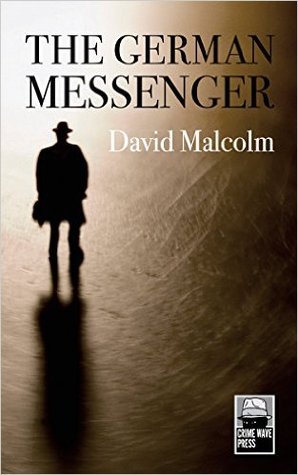
Today I have another great interview. This time author David Malcolm stops by to chat about his writing and his latest book, the spy thriller The German Messenger. Enjoy.


Interview with David Malcolm


Why don’t you begin by sharing a little about yourself.

I was born and grew up in Aberdeen in the north east of Scotland. I went to the same school as Lord Byron did briefly over a hundred years earlier. I went to university in Aberdeen, Zürich, and London. I worked for a while in rural Oxfordshire. Then I went to Japan, Poland, and the USA. I lived in Poland for four years in the mid-1980s, and after six years in the USA I went back there in 1994. I’ve lived in Poland ever since in a little seaside resort called Sopot, near Gdańsk.


Could you tell us a bit about your latest book?

The German Messenger is a spy thriller set mostly in England and Scotland in late 1916 and early 1917. There are sections that go back into the past and to continental Europe. The main character, Harry Draffen, is an agent of the British Empire who is asked to unravel a mysterious plot that the Central Powers seem to be weaving against Britain. He’s a clever but hugely damaged and embittered man, and in his investigations into the German plot he brings death and troubles with him everywhere.


Why did you decide to write in the spy thriller genre?


It’s all about lies, illusion, and betrayal. These seem to me to be what a lot of our lives are wrapped up in and made up of.


What is the hardest part of writing spy thriller fiction?

For me, it’s finding a plot that is complicated and credible enough. That’s because I’m more interested in setting, atmosphere, and character – both in the spy fiction that I write and that I read. But the demands of writing a good solid plot are much more difficult to meet than they were in, say, John Buchan’s day.


You write in several genres. Do you have a favourite? And if so, why?

I’ve been writing recently in lots of different genres and mostly short stories – crime, noir, supernatural, apocalyptic-future, Western, as well as thrillers. My favourite is, I suppose, the one that I’m writing just now. I like the possibilities that different genres lay out for you. You can go to the mean streets of LA one time, and to a post-apocalyptic England the next.


What was your inspiration?

The inspiration for The German Messenger  is clearly John Buchan’s The Thirty-Nine Steps, the classic thriller from 1915. I thought it would be interesting to rewrite that very good novel, with a very different narrator and some very different twists in the story. I’m also a great admirer of US movies from the 1940s and 1950s. Film noir has its echoes in The German Messenger even though it’s set in an earlier world.


What did you find most challenging about writing your book?

I find the time commitment required for writing a novel daunting. The novel gives you space to do all kinds of things. But it ties up years of your time – especially if you’re not a full-time writer. That’s why I like writing short stories. You finish them faster.


Did anything surprise you about the process of writing your book?

I was very surprised by some of the things that happened in the novel and what the characters did as I was writing it. Obviously that’s nonsense. I was writing it. I had the final word. But then a character would suddenly want to do something, and I would let him or her do it. It was very strange.


What’s your next project?

To finish the prequel to The German Messenger. I have part of it already. But there’s another section to be written, set in London, Paris, Lodz, and Reval (Tallinn) in 1908, involving anarhists, Tsarist agents, the Wilhelmstrasse, and the Bund (the Jewish workers’ organization). Then there’s all the other Draffen novels that are piling up in my mind. The Polish-Bolshevik War. Izmir/Smyrna. And a series of thrillers set in late 1940s and 1950s Europe with a Scottish secret agent digging into all the nastiness left over from the War. All I need is time.


You can find The German Messenger on Amazon


David Malcolm was born in Scotland. He was educated in Aberdeen, Zürich, and London.
For over thirty years he has lived and worked in Japan, the USA, and Poland. He currently resides in Sopot, Poland. His collection of short fiction, Radio Moscow and Other Stories was published by Blackwitch Press in 2015.


Thursday, 23 March 2017

Interview with Author Benedict J. Jones

Today I have another interview, this time with multi-genre author, Benedict Jones. He stops by to chat about his books, and writing in the crime, horror and western genres. Enjoy!


Interview with Benedict J. Jones


Why don’t you begin by sharing a little about yourself.

Well, my name is Benedict J Jones and I’m a writer from London who works mainly in the genres of Crime, Horror, and the Western – often blending genres together. I’ve been published since 2008 and gradually worked my way up through various short story venues until Crime Wave Press published my novella “Skewered” and collected a fistful of my short fiction along with it in “Skewered: And Other London Cruelties”. Since then my Private Eye character, Charlie “Bars” Constantinou, has appeared in two novels from Crime Wave.
In amongst that I went back to my horror roots with a grind house novella from Dark Minds Press called “Slaughter Beach” and they also collected a bunch of my weird western tales in “Ride the Dark Country”.
When I’m not writing I work for a university assisting students all around the globe and try to travel and see as much of the world as I can. As well as that I read voraciously, watch an awful lot of films, and have an interest in martial arts.


Could you tell us a bit about your latest book?

My latest book is the novel – “The Devil’s Brew” and sees the return of my character Charlie Bars who has appeared in a clutch of short stories, as well as the novella “Skewered”, and the novel “Pennies for Charon”.
Unlike the previous stories it takes Charlie out of his comfort zone of the Badlands of south east London and plants him in the bleak and beautiful countryside of Northumbria, the most remote and sparsely populated county in England. In part, it deals with the mental fallout of the violence that Charlie has previously inflicted, and been on the receiving end of. It’s the run up to Christmas and as the weather turns colder Charlie finds himself caught up in a case of ritual horse mutilation and becomes the protector of a family in peril. You can expect a mix of rural noir and British folk horror – a kind of “Get Carter” meets “The Wicker Man”.


Do you have a favourite character? If so, why?

I think it would have to be Charlie Bars as he is the character that I have spent the most time with – three published short stories, half-a-dozen unpublished ones, a novella, two published novels (and a third one that is close to being completed).
What probably draws me to him is the amount of myself that I initially poured into him but since then he seems to have taken on a life of his own. I often wonder if we were sitting next to each other in a pub having a beer would we strike up a conversation – and, oddly, whether or not he’d like me. I’m not sure he would.
A lot of people have commented that it is his inherent decency that draws people to him which always surprises me as even before the stories start he has done some very bad things. But deep down he is a very moral man, albeit one whose morals don’t quite match up with those of society in general.


You write in several genres. Do you have a favourite? And if so, why?

Writing across several genres and occasionally mashing them up usually means that whichever one I’m writing in becomes my favourite at that moment. Really, the reason I write across genres and in several is that while sometimes they bring the same things most of the time they allow me to explore different aspects of people. The viewpoint of a lot of my fiction tends to be the dark but each genre allows a different approach to the human condition.
For example the western often lets me take a more heroic approach with someone who will stride into the danger allowing me show evil defeated in some way. Whereas my crime and horror fiction often revels in the darkness of the human condition – and can allow me to bring in fantastical elements as well.


Why did you write this book? What was your inspiration?

The initial inspiration for “The Devil’s Brew” was a single scene that came to me of Charlie walking alone down a country lane, twelve-bore shotgun over his shoulder, just as the snow begins to fall. I didn’t have a clue how I was going to use the scene but it stayed with me and I gradually began to think of how I could build a story around it. In the mean time I started what I intended to be a standalone crime novel about a criminal fleeing from London to hide out in the North East and ending up trying to help a nearby family. That began to run out of steam and I realised that the character I had used for it simply wasn’t driving the narrative – in steps Charlie, as he has a habit of doing.
I had already got a lot of information regarding the area from my good friend and fellow author Anthony Watson. The landscape of that area of England was a huge inspiration for the story.
As well as that I went and re-watched a lot of folk horror films (“The Wicker Man”, “Robin Redbreast”) as well as “Straw Dogs” which I think played a big influence on certain parts of the book.


Did anything surprise you about the process of writing your book?

I am always surprised about where a book goes once I start it. I normally have a few scenes in my head and usually have a point “A” to start from and a point “Z” I want to get to. What comes in between always surprises me!
In part that organic nature of the story is part of what brings me back to writing each time. I like the characters to grow and speak to me and, perhaps, diverge along paths that I hadn’t previously foreseen.
It’s extremely rare that I will plot a whole story out. I like to see where the words take me and what occurs to me as I write. This can sometimes be problematic and lead to stories stalling but on the whole I like it and I don’t think I could ever be one of those writers who plots every scene out before they start – but this is just what works for me, to each their own when it comes to the creative process.


When did you realize you wanted to be a writer?

That I think has always been with me. I have always written since I was old enough to hold a pen, and always made up stories in my head. When I was about nineteen I realised the urge and wrote a novella. Which then went into an envelope and onto a shelf. But the bug had truly bitten and I sporadically wrote pieces of short fiction which, again, I didn’t do much with.
Then about eleven years ago I decided that this was what I wanted to do and I got stuck into it. I wrote constantly and gradually began to work earlier ideas into readable stories. A ‘zine called “One Eye Grey” picked up my short story “Goin’ Underground” and then I just built from there.


How do you research your books?

That is very dependent on what I am writing. A lot of my crime fiction comes from things I see and have heard rather than from traditional research. But even in that there are things I want to know more about and get right. For instance, when I wrote “Pennies for Charon” I needed to brush up on my Greek myths, for “The Devil’s Brew” I watched documentaries on dog fighting and had a friend who lives in Northumbria send me pictures from his walks in some of the remote spots.
When it comes to my Westerns I probably do a lot more “book” research. Mainly because I hate seeing anachronisms in films or reading them in stories. One of my worst moments was when a reader of one of my early western shorts contacted me to say he thought that the hero fired one more shot than he had available to him. I checked and, well, let’s just say when the stories were collected for republication he fired one less… Thanks for spotting that one Ross Warren!


What’s your next project? Any upcoming book secrets you care to reveal?

I am working with putting the final touches to the next Charlie Bars book. This one touches on the British political establishment and one of the dark scandals that has dogged it for years. It is my attempt to make sense of certain things that have come to light and wondered how the hell they could have been allowed to happen. Mix in some British gangsters, the shady world of post 9/11 espionage and Charlie is once again up to his neck in grief.
Apart from that I have returned to my horror roots and have a couple of short stories coming out in a pair of projects that look to be very exciting. I’m also still working away on a pair of longer length works set during the second world – so many things on the go and so little time.


You can find all of Benedict Jones' books on his Amazon page.


About the Author:
Benedict J. Jones is an author of crime, horror and western fiction from south east London. His work has been published in various anthologies and magazines. Since 2008, he has published almost thirty short stories. His books include, Skewered: And other London Cruelties, Pennies for Charon, and The Devil's Brew
Check out his website for further info: www.benedictjjones.webs.com or follow Benedict on twitter @benedictjjones.

Tuesday, 7 March 2017

Interview With Crime Author Greg Barth

Today I have a interview for you, with author Greg Barth, who chats about writing crime noir, and his books. Enjoy!

Interview With Greg Barth


Why don’t you begin by sharing a little about yourself.

Sure. I’m Greg Barth, and I write in the crime noir genre. If I am known at all, it’s for the Selena series (Selena, Diesel Therapy, Suicide Lounge, Road Carnage, and the soon-to-be-released series finale, Everglade).
I have a thing for characters in desperate situations without good options. I don’t write the traditional thriller novel about someone who is the smartest person in the room, the person who is always right, and who never fails. My characters get in over their heads. My characters make mistakes. My characters get hurt. Sometimes seriously hurt.


Could you tell us a bit about your latest book?

Road Carnage picks up Selena’s story in the bloody aftermath of Suicide Lounge. She is lying low, healing up, and trying to put her life back together. A new enemy comes into her life and threatens her freedom—an elusive young man who holds her fate in hand. This guy has connections to the nastiest criminals in the south. In a desperate attempt to protect herself and those she’s grown to love, Selena blazes a blistering, high-octane path through the southeast leaving blood-drenched carnage in her wake. This is the most visceral and violent entry in the series. Few get out alive. No one gets out unscathed.


Do you have a favourite character? If so, why?

Selena is my favorite character. When we first meet her, she’s an alcoholic, drug addicted, prostitute living careless and sloppy from one high to the next. She’s a stripper who cannot even start her car without proving she is sober to the ignition interlock device installed by the county.
When an act of petty theft places her in the crosshairs of a local crime syndicate, Selena is violently knocked over the brink. The only mistake her enemies made was leaving her alive—alive and hungry for revenge.


Why did you decide to write in the noir genre?

I like the high stakes. I like the very real threat that the protagonist just may not make it out alive. It gives the sense that no one is safe. I also like protagonists who aren’t perfect, have no good options, and make mistakes. Costly, often deadly mistakes.


Why did you write this book? What was your inspiration?

There were several pieces of inspiration. TV shows like the Sopranos and Breaking Bad taught me the unpredictability of the anti-hero. Stieg Larsson’s The Girl with the Dragon Tattoo evolved this into the anti-heroine. That one also showed me how a female protagonist can suffer violence and display an emotional range that male characters can’t get away with and still earn sympathy from readers. I was also reading a good bit of Ken Bruen’s Jack Taylor series at the time. Jack, as you may know, is a heavy user of drugs and alcohol. I began to toy with the idea of whether you could pull off a character like that as a female. There’s also a touch of the old rape/revenge movie genre in Selena—think of movies like Death Wish and I Spit on your Grave. Those and a hundred other things inspired the character Selena.


Did anything surprise you about the process of writing your book?

The thing that surprised me the most was learning that building a story and writing a story are two different actions. You must have a story to tell, and stories are made up of several defined components. How you write it (novel, comic, movie script, etc.) is just the medium for the story. I don’t consider myself a particularly gifted writer. I keep it simple. My technique is just going with the basics. I figure it takes an incredibly talented storyteller to tell a mediocre story in a compelling way; so, I make certain I have a strong story. If you have strong story, almost anyone can tell it.


Can you tell us about your writing process? Where do your ideas originate? Do you have a certain writing routine?

I write every day, but I don’t “write” every day. In other words, I’m always turning ideas over in my head, coming up with scenes, connecting them to other scenes; but I don’t sit down and peck away at the keyboard every day. I have a lengthy commute. I spend 70 miles in the car five days per week. During that time, I am listening to music and daydreaming scenes in my head. At night, I’ll jot them down on a digital corkboard. Once I have three or four strong scenes, scenes that can carry a book, I come up with the sequences that lead up to each scene. Once I have those, it’s time to write. The actual writing takes about two weeks to get the first draft. That’s because I already have the book in my head, I just have to get it down.
When I am actually writing (pecking away at the keyboard), I get quite manic. I can’t sleep much, and when I do I dream as my characters. I’m constantly waking, typing—it’s almost non-stop mania until I get the first draft done. Then comes the polish.


What is your greatest challenge as a writer?

The hardest part of the writing process is what comes after the book is published. Writing is a lonely, personal craft. I enjoy building the story, writing the story, and applying the first coat of polish. If writing is a solo effort, publishing is a team sport. There are a few rounds of edits during which you are working with a professional team. By the time the book is actually published, I’ve read the manuscript so many times I am too close to it to even know if it’s any good. Once it’s out, you are left waiting for reactions from your readers. Will they like it? Will they think it sucks? You never know. Someone once said, If you don’t want the thing you created to suffer criticism, then it’s better to not create anything to begin with. It’s always a little scary to have this thing you created out there for everyone’s reaction.


Do you have a favourite author, or writing inspiration?

Richard Stark is my favorite author. Stark is one of the pen names used by Donald E. Westlake, but I always think of him as Stark. His character, Parker, was my first introduction to a protagonist who is completely amoral. Parker was a shock to the system at the time and has been a steady supply of literary crack that I go back to time and again. That twenty-four-volume series is just perfect.


How do you research your books?

YouTube. You can learn anything on YouTube. How to fire any weapon? Check. How to smoke hash resin? Check. How to make baked spaghetti? It’s all on YouTube.


What advice would you give beginning writers?

If you aren’t rich, get a good day job. The best you can find—something professionally and financially fulfilling. You’re going to need it. Either that or a spouse who can support your family financially. There’s no comfortable living to be made in writing. I think of writing as a craft. A simple art. My grandparents used to make quilts. They were good at it. Every now and then they’d sell one or two. I think of my books like that—craft quilts—only I can sell these over and over. It’s fun. It’s fulfilling. It brings a lot of satisfaction. If you crack the code and find a way to make a comfortable living as a writer, then I’ll be asking you for advice.


About the Author:


Greg Barth is the author of Selena, Diesel Therapy, Suicide Lounge, Road Carnage, Bona Fide Jobs,Where Moth and Rust Corrupt, and Everglade. 
Greg cut his literary teeth by reading the Parker novels by Richard Stark. The Stark influence is evident in Barth's lean, compact  prose. As a fiction writer, he has a thing for amoral characters in bad situations; without good options, they proceed to make things worse for themselves. 
A devoted fan of noir fiction in all its forms, Greg is also the host of Noir on the Radio, an affiliate of the Authors on the Air Global Network. He lives and writes in Bowling Green, KY.

For more about the author and his works, visit his publisher’s website: All Due Respect

Or see what he has planned on his Amazon Author Page

Join host Greg Barth on Noir on the Radio and experience rare glimpses into the creative lives of authors of noir and crime fiction from around the globe. Call in and ask the him or the guest a question.

For info on upcoming live shows or podcasts: 


Tuesday, 24 March 2015

Blondes, Books, and Bourbon Blog Tour

Welcome all you practitioners and fantasy fans. We're taking a journey back into the world of Jonathan Alvey and the White Dragon Black series today as a stop on the Blondes, Books, & Bourbon Blog Tour.


Sublime Noir And Urban Fantasy


Blondes, Books and Bourbon, is a gritty, witty, and downright entertaining series of short stories. The character of Jonathan Alvey, and indeed the whole White Dragon Black series, reads as if the author mixed Harry Dresden and Phillip Marlowe in an acid bath and then etched the page in the peerless prose that resulted.

The stories in the anthology vary in tone and temperament, some irreverent and funny like What a Nightmare (which reminded me a bit of a slapstick comedy), others darker and more foreboding such as The Cost of Custody, or The Ties That Bind.
I enjoyed this anthology greatly, and every enchanting story was a treat to read. In addition, there’s a fun character interview with a twist, and a tantalizing sneak peek at the next novel the White Dragon Black series. I highly recommend Blondes, Books and Bourbon.


Get to Know the Author:

1. Please share how you came up with the concept for your short stories? Which of the stories was the easiest to write and which was the most difficult?

All of my writing comes from my Muse, I can’t construct a story myself. From my perspective, I don’t create my tales - I just record them. Now doesn’t that make me sound crazy? But it’s true – the majority of the stories I write, are idea’s that come to me as snippets of conversations, or little scenes that play out in my head as images. My challenge is to turn those into words that capture what I ‘see’.

In many ways, ‘The Ties that Bind’ was the hardest story to write, as I wanted a thread that connected it to the next novel, ’Bindings & Spines’ and yet allowed the story to stand all its own. That made for a challenge that I truly enjoyed.

The easiest one to write was probably, ‘Sins of the Father’. Being the first story written in that world, I had no restrictions, no rules, and no history. I didn't have to keep anything straight, remember details, or worry about contradicting myself. Of course, when I wrote it, I had no idea that it would spawn so many other short stories, and novels.


2. Please name some of your other published works?

Tomorrow Wendell - first White Dragon Black novel
Horror Library, Volume Three – ‘Blink the Blood Away’
Tales of the Talisman Magazine, Volume 1 Issue 4 – ‘Pigeon Pete’
Mental Wellness: Real Stories From Survivors – ‘Ceaseless Cycles’
Legends and Lore: An Anthology of Mythic Proportions – ‘Charon’s Obol’


3. What is your preferred writing genre?

I’m a paranormal / urban fantasy author mainly, but I cut my teeth with horror, and that will always have a dark spot in my heart. I’m sure my mind will churn out some further grisly morsels yet.


4. And preferred reading genre?

When it comes to reading, I’ll take just about any sort of spec-fic, as long as it’s well written. Sci-fi, horror, fantasy, alt-history – give me a well told story, and I’m yours for the duration.


5. What are your top 3 favorite books?

Ignoring how awful question that is to ask of any book lover, these are three I certainly always come back to, both physically, and in my mind:
‘The Dark is Rising’ by Susan Cooper was my favourite book as a child, and it still ranks in the top three.
‘Snow Crash’ by Neal Stephenson was an amazing journey meshing cyber-punk, ancient myth, and philosophy and thus must have a place here.
‘Someplace to be Flying’ by Charles de Lint, in many ways is one of my favourites of his works. There is a darkness to it that really appealed to me and it stepped away from some of the better known characters and giving a fresh view into an odd world.


6. Do you have any particular writing habits?

You mean good ones? I try to get my writing done at the beginning of the day. After enough coffee to find words, I sit down and write what my Muse deigns to share with me. That way, no matter what else the day throws at me, I have got the important part completed.


7. Do you have a playlist that you created while writing your story?

Yes, definitely. It grows and shrinks every so often, as songs no longer seem pertinent to the world, or I find new meaning in songs that inspire me. I also have subsets for the different moods Jonathan goes through and, of course, one for fight scenes.


8. Panster or plotter?

Panster – Absolutely Panster! If I even try to plan a chapter ahead, the entire train of thought comes to a painful screeching halt and I’m left, chin in hand, staring at a black page, listening to the sheep Baa.


9. Advice for writers?

I think there are two things that I would recommend, one is easy and the other sounds hard, but is actually just a change of mindset. First advice is a standard – Just Write. Get it down, and don’t look back until you've told the story. The second thing is - Learn to Love Edits. It sounds impossible, but editing is just writing from a different angle. It is the same process, same creativity, same weaving of words but you are doing it from outside the box instead of inside.


10. What's up next for you?

Any moment now, my editor, McKenna Gardner, who worked wonders with my first novel, ‘Tomorrow Wendell’ and acts of magic to get, ‘Blondes, Books & Bourbon’ together, is going to show up with a red pen, and a cattle prod.  This will be my cue that she intends to help me get the second White Dragon Black novel, ‘Bindings & Spines’, ready for publishing. Everyone should take a minute and thank McKenna for making these works exist, by the way.


11. Please provide some insight, a secret or two about each of the stories.

‘Interview’ was actually written for a blog that was promoting the first White Dragon Black novel, Tomorrow Wendell’. They asked for a character interview and that really gave me pause. I tried to wrap my head around what sort of circumstance would find Jonathan Alvey giving an interview and realized there was only one. 

‘The Play’s the Thing’ is the second story written in the WDB world. It was a fun tale to write, and I did so quickly, but it opened up a deeper understanding of both Jonathan, and his world, for me. It was also the story that made me realize I would be seeing a lot more of that character in my future.

‘The Cost of Custody’ was written as a submission for Xchyler Publishing’s open call for their next anthology. It was the first time I had submitted anything involving Jonathan, and I was actually quite surprized when it was accepted into ‘Shades and Shadows: A Paranormal Anthology’. This was the first time the public was exposed to the character who had taken over all my writing time… clearly it was only the beginning.

‘Sins of the Father’ is the story that started it all. At the time, it was quite a digression from my usual style. I thought it a one off, a cute tale that stretched my writing ability and nothing more. However, once it had been written and edited, I found the writing department of my mind had been cleared of everything but a brooding figure with his feet up on a battered desk.

‘Legerdelivre’ was written long ago, and then about a year after, my Muse showed me a different possible ending to the story. I enjoyed it in my head but never put it into words. When we were editing that story for ‘Blondes, Books, & Bourbon’, I told my editor, McKenna, about the alternate ending and asked if she’d like me to write it up. She suggested I should write it and another, if I could. It wasn't that the original ending was bad, but the idea of managing to get a better one, was tempting. I went to work on it immediately, and not only wrote out the one I’d carried in my mind for quite some time, but a third ending as well. The version that is in this anthology is actually the best parts of all three ending fused into one. It wasn't the easiest to pull off smoothly, but I couldn't be happier with the way it turned out.

‘Do As I Say, Not As I Did’ holds a special place in my heart because it a story that shows that Jonathan can intentionally be, when he really wants to, a bit of a jerk. That, to me, is simply entertaining. Hmm, maybe this says something about me I should admit in an interview.

As I said, my stories come from my Muse, but sometimes I can say, ‘Hey, can we work with…’ and she’ll give me a story, there are two of those in this anthology. For the first, I wanted a story that was centered on Jonathan and his problems with keeping a secretary. That was it. That was what I asked for. After a day of musing (where do you think the term comes from?) what I got, was the story, ‘What a Nightmare’. The second was ‘The Ties that Bind’ and it came about because I wanted a short story that tied into the next novel ‘Bindings & Spines’. I wanted to create a tale that stood alone but, when read in conjuncture with the novel, enriched the understanding of the what, and why, of Jonathan trying to go ‘clean’ from magic.


Author's Favorite Things:

- Quote - “Don’t you smile at me like that … that’s not even a real smile! It’s just a bunch of teeth playing with my mind!”

- TV show – Doctor Who. I mean ALL Doctor Who; not just the new, not just the old. Doctor Who.

- Comic book character – Death from Neil Gaiman’s ‘Sandman’

- Movie – Casablanca. Is there any other possible answer?

- Candy bar – Big Turk. I mean, how can you say ‘No’ to Turkish delight and chocolate?

- Junk food – White Chocolate. No, wait, ice cream. No, Gin. No, gummy bears. Coffee?

- Place you visited – I haven’t traveled much, or very far. The trip to Wales, my mothers country of birth, was taken when I was young but even so it floats in my dreams always.

- Restaurant – The mom and pop diner, in the small town where I live. They have big inexpensive breakfast served all day, and burgers that just hit the spot every time.

- Island – Roke. There are, I’m sure, many wonderful ones out there but I take Roke as my choice.


AUTHOR BIO:


R.M. Ridley lives with his wife on a small homestead in Canada, raising chickens and sheep. He has been writing stories, both long and short, for three decades, the themes of which range from the gruesome to the fantastical.
As an individual who suffers from severe bipolar disorder, Ridley is a strong believer in being open about mental health issues and uses his writing to escape when his thoughts become too wild.


BOOKS: 
WHITE DRAGON BLACK
Bindings and Spines (Book 2, 2015)
Ridley's work has appeared in two Xchyler anthologies: "The Case for Custody" in Shades and Shadows: a Paranormal Anthology, and "Charon's Obol" in Legends and Lore: An Anthology of Mythic Proportions.

WHITE DRAGON BLACK: Google + | Twitter
FIND THE AUTHOR ONLINE:

Subscribe Now:

Search This Blog

Powered By Blogger

Monthly Pageviews