Showing posts with label folklore. Show all posts

Monday, 17 September 2018

Scath Oran Blog Tour: The Banshee

Today, the blog is a stop on the Scath Oran book tour and I have a guest post by author Stacy Overby on one of my favourite subjects, the Banshee. I also have a look at Stacy's new poetry book, Scath Oran, so enjoy.


The Banshee


Banshees. They’re the quintessential mythical creature when it comes to creepiness and death. Many movies and stories include them, but what—beyond their shriek—do the stories tell about banshees? That question drew me to explore the myths surrounding banshees when writing Scath Oran.
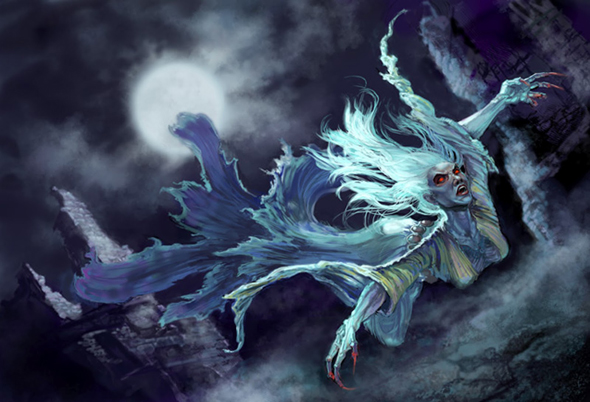


Banshee Origins

The origins of the banshee are somewhat clouded, but one drew my attention. It is said that the banshees came from women who died during childbirth. These women-turned-banshees roamed, portending death, until they reached what would have been the end of their natural life. None of the myths talked about what happened from there, but the implication is that they passed into their version of Heaven or paradise. Other legends talk about banshees being created from women who were murdered. It seems that, regardless of the method, legends say banshees are created from women who meet tragic ends.
With this origin myth, the banshees would presumably appear as young women. While that was sometimes the case, it did not always hold true. This is one place where the Celtic belief in Maiden, Mother, Crone shows up. Just as often as the banshee appeared young, she also would appear as an older woman to an old “hag”. Another image from Scotland painted of the banshee was a woman washing bloodied clothes at the ford in a river. The one who saw her there washing the bloodied clothes would soon die.


The Banshee Cry


The keening and wailing of the banshee is perhaps the most classic aspect of the banshee, and the one most often thought of when the banshee are mentioned. Most legends agree that this cry is about warning someone of impending doom. Some legends say the banshee only cry at the death of a true blood Milesian Irish. Others talk about the number of banshee keening signified the greatness or holiness of the person who died.
Scholars believe the wailing of the banshee stems from a different Irish tradition. At funerals, the Irish would hire keeners to wail laments at a death. The better the keener, the more in demand she was. With this association with death and funerals, it is easy to see how this tradition crossed the line to become something more in legends.


The Fairy Connection

Another interesting aspect of banshees is that some Irish believed the banshee was a fairy woman who would bear the news of a loved one’s death. This held true even when the person died far from home and family. Thus, the banshee would be the herald bearing the news of the death before any human messenger could bring the sad tidings.

Also Known As

The banshee had multiple other names as well. She could be known as the bean chaointe, or keening woman. Bean nighe, or other variants, meaning little washerwoman or washer at the ford, is a Scottish variation to the banshee myth. The hag of the mist was yet another variation of the banshee stemming from Welsh legends. Which name was used depended on the region in which the story originated.


Other Facts


The intentions, and dangerousness, of the banshee also varied depending on the legend being studied. Some banshees were said to be closely tied to their families and their cries were sorrowful laments of the loss to the family. Other banshee legends talked of angry and vengeful female spirits who frightened and tormented those who heard her cries. A few even speak of the banshees causing the deaths they sang of, rather than just reporting them.
One of the most intriguing pieces of information on the banshee I found was about the beliefs in banshee. For many centuries, not believing in banshee was blasphemous in the British Isles—Ireland in specific. While this has waned in modern times, there are still those who believe in the existence of banshees as something more than myth and legend.


So, there you have it, a brief history of the banshees. They are featured several times in Scath Oran, including a story about how one banshee came to be. Scath Oran is available on Amazon and Draft2Digital. You can find me at www.thisisnothitchhikersguide.com.


Scath Oran: poetry from the Otherworld by Stacy Overby 


The Wee Folk. The Fae. Fairies.

Whatever you may call them, they have whispered secrets in this collection of poetry plucked from the halls of Tír na nÓg. But, be forewarned, not all is as it seems on a journey through the shining realm. Come, take a step into the fairy ring as songs of the Fae drift on the damp night air. 

Scath Oran: poetry from the Otherworld
releases September 22nd, 2018 and is available at
Draft2Digital


For more stops on the tour check out the list: Scath Oran Blog Tour


Thursday, 13 October 2016

The Number 13: Day 4 of #OctoberFrights


Welcome to Day 4 of the October Frights Blog Hop!


Today is the 13th of October. It is also #FolkloreThursday over on Twitter, so it seemed a perfect time for a post on the myth and folklore of the number thirteen.


We all know the superstition, the ominous unlucky number thirteen, scourge of digits and integers, and striking trepidation in many. And of course, should the dreaded date of the 13th fall (gasp!) on a Friday, well...

This belief in the unlucky quality of thirteen is quite pervasive from the aforementioned Friday the 13th to high rise buildings actually lacking a thirteenth floor. So what are the origins of this belief? How did thirteen come to symbolize bad luck? What heinous crime did it perpetrate to be labelled Bad Luck King of the number world?

Nobody’s quite certain.

One of the most popular theories as to its ill-fated origins is the Christian one regarding Judas Iscariot being the 13th member to arrive at the Last Supper. While this idea may have spread the fateful notion of a bad luck thirteen, it was probably not its origin. However, the superstition of 13 being an unlucky number at a dinner party has some validity, and goes back to Norse mythology. In some versions of the story of the Death of Baldr, the trickster god Loki is the thirteenth (and uninvited) guest at a celebration feast. It is at this celebration Loki tricks the god Höðr into killing Baldr with mistletoe. So one could see how thirteen guests might now seem unlucky at a dinner party, and perhaps spill over into other areas.
But this idea of “bad luck thirteen” doesn’t translate well past Western culture. 
Ancient Egyptians and Aztecs considered the number fortuitous, and in some Asian culture, the number four is the unlucky one. Perhaps it is simply a matter of poor thirteen being in the wrong place and the wrong time, and labelled bad for eternity.


Some Tidbits:
  • In folklore tradition, thirteen turns make a traditional hangman's noose (In actual practice not so much)
  • Some airplanes have no 13th row and some airports skip the 13th gate
  • Many cities do not have a 13th Street or a 13th Avenue
  • Friday the 13th can only occur in months starting with Sunday
  • The actual fear of the number thirteen is called triskaidekaphobia
  • Triskaidekaphilia is the love of the number 13
  • Thirteen at Dinner is a US title of an Agatha Christie mystery novel


Further reading:


And now for the Giveaways!


You can check out my Halloween Horror Haiku Giveaway! (live until October 31st) by clicking on the Giveaway Tab at the top of the blog or this link: Halloween Horror Haiku Giveaway!


And here's my October Frights Book Giveaway!


And now you can continue on your journey, and check out the rest of the Blog Hop and the delights these wonderful people have in store.

Thursday, 25 October 2012

Ghosts, Beasties, And A Werewolf: A Coffin Hop Book Review

Today's Coffin Hop post comes chock full of monsters and ghosts, courtesy of the book  The Lunenburg Werewolf: And Other Stories of the Supernatural by Steve Vernon.  Here's my review.

My Book Review of The Lunenburg Werewolf: And Other Stories of the Supernatural by Steve Vernon:

I love a good ghost story, and The Lunenburg Werewolf: And Other Stories of the Supernatural by Steve Vernon is full of exceptionally good ghost stories, plus fabulous tales of monsters, pirate gold, fairy folk, demons and devils. It’s positively oozing those “creepy tales to tell around the campfire” and the “keep the lights on while you read” scary moments, yet it still maintains a black and whimsical sense of humour.

The book is darkly delightful. My fellow Nova Scotian, Steve Vernon, has collected an odd assortment of horrific tales, from the far corners of our fair province of Nova Scotia, and woven them into a first-rate and entertaining book of folklore. Between the covers you will find the ghostly Lady in Blue, the Phantom Ship of the Northumberland (my favourite ghost story), a Phantom Artist, a Black Cat that lingered after death, Beasts, Selkies, and of course the aforementioned Lunenburg Werewolf.

The author knows how to spin a satisfying yarn, weaving fact, history and folklore into a compelling read. Be the tales truth, fiction or a little bit of both, The Lunenburg Werewolf may leave you believing in ghosts. Or at least loving their stories. I can give The Lunenburg Werewolf: And Other Stories of the Supernatural a high recommendation; just be sure to leave all the lights on when you read it.


The Lunenburg Werewolf: And Other Stories of the Supernatural

The wind is howling and a full moon is in the sky-it must be time for more chilling tales from storyteller Steve Vernon. Spanning the length and width of Nova Scotia, these 25 blood-chilling yarns make perfect campfire fare. Some stories are so terrifying that they have been told far and wide, such as the Ghosts of Oak Island or the haunting of Esther Cox. Others, including the Murder Island Massacre and the Caledonia Mills Spook, might be lesser known, but are no less scary. Written in Steve Vernon’s unique style, these stories of the haunted, the supernatural, and the unexplainable are part history, part folklore, and a lot of old-fashioned, frightening fun.

The Lunenburg Werewolf: And Other Stories of the Supernatural is available at:
Chapters Indigo
Amazon.ca
Amazon.com
Kobo


And please visit the other Hoppers today.  Just scroll down to the bottom of the blog and check out our list.

Subscribe Now:

Search This Blog

Powered By Blogger

Monthly Pageviews