Showing posts with label literary novel. Show all posts

Monday, 15 July 2013

Sunflower by Cass McMain

Book Spotlight and Excerpt:


Sunflower by Cass McMain

Michael is a metalworker with a name for building good fences. He’s even known by some neighborhood kids as Mr. Fence Man. But he wants to be something more: an artist like his former business partner, Alex. An artist, like his girlfriend, Jess, wants him to be. The commissions are starting to come in, and along with steady work making fences, things are looking good. The only problem he has is with his closest neighbor, who won’t allow visitors to pass through a gate between their properties. This dispute becomes a fight and Michael, enraged, makes a wrong choice.
Haunted by the result of his choice, Michael starts to fall apart: a death weighs down on him, exposing the weaknesses in the persona he was creating for himself, the weaknesses at the heart of him.
Sunflower is a story about a man having a bad day and making one bad choice. But underneath that, it also about his coming to terms with himself: who he is - and who he is not.  Ultimately, Sunflower is about how we define ourselves as people, and how we seek to be what we are not.

An extraordinary and beautiful novel.

"Yet in the end this about strength and hope, about life-giving light as well as life-denying darkness. It is indeed a story of small things and profound truths."
Robert Peett, Editor's Review


About the Author 
                                 
Cass McMain was born in Albuquerque and raised in the far North Valley, among the cottonwoods. Her first love was always houseplants, and she now maintains a house full of them.
Her background as a greenhouse manager led to a long career in garden center management, but when the bottom fell out of the local industry, she took a new path. Or rather, an old path; Cass started writing at the age of six, knocking out stories on her typewriter.
While her love of nature came in part from her father, a man with the heart of a farmer and the soul of a philosopher, much of the writing Cass did as a child was done to please her mother, a woman with the heart of a philosopher, the soul of a demon and the unquenchable thirst of the mind reserved for the brilliant.
Recently, Cass’s writing muse has again been speaking to her: a voice she stopped paying attention to a long time ago. Her plants, some of which she has had since she was nine years old, remain the heart of her life, but now she has a desire to express herself in other ways.
Bowed, but not broken, Cass keeps her eye on the horizon, looking for a greenhouse to manage. Her favorite saying these days is “that was then; this is now.”


An Excerpt from ‘Sunflower’:

Michael got home late in the afternoon, and he was worn out. He didn't feel like working on the Tragedie piece. But if he didn't do anything on it, he knew Jess would nag at him. Maybe he could sort of review it, without a lot of work. Those guys had taken a lot of energy out of him. He mixed himself a gin and tonic and walked out to the shed.

The piece stared at him. He wondered again why the owner of this restaurant was so determined to have such a somber image as their icon. That reminded him about the curls he was going to try on the cheeks. He set his drink down and took up the coil he had experimented with before. The heat from the torch had definitely brought out some different coloring. Michael decided to give it a shot on a grander scale.

Working with a much larger strip of metal, Michael fashioned a coil about a foot across and two inches thick. To change the color of it he fired up his torch and played the flame across the metal. This gave the coil some irregular markings that brought out depth and made it more interesting. Michael ran his hand along the edge and realized it was dangerously sharp, so he ground down the edges and ran the torch over it again. He doubted anyone would be actually petting the artwork, but it wouldn't be smart to take the risk.

Once the metal was curled, he welded it to the cheek of the mask, under the left eye. The mouth was unevenly curved by design and as Michael worked he came to the conclusion that the second curl should be placed lower, to follow the direction of the mouth. He stepped back to look at the piece from a distance, and bumped into the table which held his drink. Michael caught the drink before it spilled, and absent-mindedly swallowed it at a gulp. The ice had melted; he had not realized how much time had passed, and it was now after 5:00.

Michael set down the glass again. It can’t be that late, he was thinking, when he heard Jess pull into the driveway. It was indeed that late. He went out to meet her.

She stepped out of the car. Her cotton skirt blew out behind her as she moved toward him, making her look almost like she was floating.

“Hi sweetie,” he called to her. “How was your day?”

“Was OK, how about yours? Get anywhere on your mask?” She caught up to him and gave him a peck on the cheek.

“Yeah, come look at this idea I got,” Michael said enthusiastically. “I really think this helps the piece look less formidable.” He led Jess to the shed.

She looked in at the mask. “The curlicue?” she asked. When Michael nodded, she said “I like it. Doing another on the other side?”

“Yeah,” Michael said. “Down lower though, to keep with the mouth.” He pointed at the spot. “Think it helps?”

Jess agreed that it did make the mask less frightening. “But it still looks mean,” she said. “It isn't supposed to look mean, it’s supposed to look sad.”

“Well, I don’t know what else I can do,” Michael said. He was irritated, but he tried not to let it show. Easy for her to say, he thought. “What do you think I was trying to do with the curls?”

“Honey, don’t get upset,” Jess replied. “I just mean—well here, why don’t you add some turned down eyebrows?” She took up a notepad nearby and sketched. “Like this.” She held the pad up for Michael to view.

It was perfect. It would only take a couple of hours to do, and it would completely change the piece. Michael was stunned and, he hated to admit, resentful. She did in three seconds what I couldn't do in three weeks, Michael thought. Just like Alex.


Sunflower purchase links:

Amazon: http://bookShow.me/1909374458

Barnes & Noble : http://www.barnesandnoble.com/w/sunflower-cass-j-mcmain/1115472420?ean=9781909374447

Waterstones : http://www.waterstones.com/waterstonesweb/products/cass+j-+mcmain/sunflower/9610594/

Foyles : http://www.foyles.co.uk/witem/fiction-poetry/sunflower,cass-j-mcmain-9781909374454

Wednesday, 8 August 2012

Interview With Author Robert Ford

Today we are joined by writer and filmmaker Robert Ford, who stops by for an interview:
 
 Interview With Robert Ford

1- Why don’t you begin by sharing a little about yourself.

Hello. My name is Robert Ford. I live in London and divide my time between writing and working in film and television on the editorial side of things. Currently in training for the Graeco-Roman wrestling, Rio 2016.

2- You’ve written your first novel, The King of Spain.  Can you tell us a bit about it?

The King of Spain is set in an old people’s home, in the future. It’s a dark comedy about the people who work there and the adventures they have. It’s quite silly but very serious and hugely entertaining. Of course.

3- What inspired you to write this particular story?

The King of Spain came about through a collision of elements, of thoughts and concerns. There were a set of personal strands that I wanted to explore and a set that were more global. It sound obvious, but the more I thought about things, the more I came to realize that these two tracts were absolutely interrelated, and it was from that starting point that everything else flowed.

4- You’ve written several screenplays, as well as the book.  What is the biggest difference you’ve found between writing a screenplay and a novel?

I loved the freedom that a novel affords you. You don’t have to think about the physical or financial constraints of making the final film. About casting or time pressures or any of those things. It felt liberating, not least in the respect that I could suddenly use language in a much more sophisticated manner - my screenplays were probably over cooked in terms of stage directions etc. At the same time I tried to remember that with a screenplay you can conjure a scene, and introduce characters with very few words. There is an economy inherent in their form and at their best this allows the reader to flex their imagination, which is a real strength.

5- You’ve also worked in film and had your directorial debut with Sexy Pig, broadcast on the BBC HD channel.  What was that experience like?

It was great, especially as the film was shot for no money and with no resources. Felt like we achieved a great deal with not much.

6- What is a typical day of writing like for you?

Unfortunately I rarely get to write during the day. More often I’ll write at night, when the rest of the world is sleeping.

7- What’s your greatest challenge when it comes to writing?

Finding time. Ideas come to me easily. I write slowly but I get there in the end. The biggest issue I have is finding time after work to write, especially now that I have a daughter. And I’m not someone who does well off no sleep, although I’ve had to adapt. My greatest wish is that one day someone will pay me to write. During the day.

8- Who are your writing inspirations?

Lewis Carol, Hubert Selby Jnr, Hunter S Thompson, Charles Dickens, Graham Greene, Roald Dahl, Haruki Marukami.

9- What’s next for you?

Once all the 4p royalties are in from the book I plan to buy a boat. Well, a rubber dinghy anyway. Yachts are so, like, last year. The dingy is a classic design and cheaper to run. My wife has offered to row us across the Irish Sea so we may hole up in Dublin for a while. TBC.


Author Bio:
After graduating from Reading University in 2003, Robert Ford briefly worked as a journalist in India before turning to the world of film editing, where he has been employed ever since. As well as prose, he has written several screenplays, and his directorial debut Sexy Pig was broadcast on the BBC HD channel last year.
He now lives and works in north-west London, roaming the streets in search of inspiration, drinking too much coffee and not writing as much as he should.

The King of Spain
When unworldly 22-year-old Sam is offered the chance to swap life in his regulation bungalow for a job at a countryside retirement home, he drops everything and heads to the rolling fields of Sussex. But things at the eerie Edge Hill are far from what he imagined.
The residents are easily over 100 years old, but due to rigorous cosmetic upkeep they look like they are in their twenties. The strange ‘handlers’ who work in the facility seem to have everything under control – until a geriatric stampede sets off a mind-blowing sequence of events that threatens to alter his life for ever.
In this sensational debut novel set in the not-too-distant future, Robert Ford has created a universe of his own in order to brilliantly illuminate the one – and the age – we all share…
 
The King of Spain:


Tuesday, 28 February 2012

An Intense Literary Apocalyptic Novel: A Review of Since Tomorrow

My Book Review of Since Tomorrow by Morgan Nyberg:


Since Tomorrow by Morgan Nyberg is an unsettling novel, in the way only a powerful, well-crafted book can be, using its words to twist into your mind and make you think. It’s the type of book that resonates right into the back of your mind and curls around your soul.

The book is set in a post-apocalyptic future, where excess and dissipation have finally caught up with the world and where society has self-destructed. The novel unfolds within the city of Vancouver, Canada, where a small population survives, eking out a meagre existence by farming and scavenging.
This is a magnificent book that lays out an exquisitely formed vision of a broken world that has lost the trappings of civilisation as we know it, but none of its emotional underpinning. In this new society we still find people trying to form communities, people trying to take advantage, some who have given up, and some who want to make it better. No punches are pulled here in the pages; characters die, both victories and tragedies happen and life goes on despite everything. The author gives you characters you can love and hate, all living in an amazingly realistic future world.

In so many ways this book just works effortlessly, giving the reader different levels of enjoyment or reflection in its words. I highly recommend this book; it is worth your time to read it.
 
 
Since Tomorrow is available at:
Amazon

Monday, 19 December 2011

Interview with author Robert Lamb

Today the blog is going from geek to chic, with a visit from literary author Robert Lamb as he chats about his books and writing...


Interview with Robert Lamb


1. Why don’t you begin by sharing a bit about yourself and your writing?

I teach writing and American literature at the University of South Carolina, to which I came after a 20-year career in journalism, last with The Atlanta Constitution. I joined USC as a publications writer/editor, but was invited to teach after my first novel (Striking Out) was published and was nominated for the PEN/Hemingway Award. Been teaching ever since as an adjunct professor. I've been writing fiction since I was 10 years old, beginning when I was inspired by the movie "Gentlemen's Agreement," starring Gregory Peck as a magazine writer doing undercover expose on anti-semitism.


2. Would you please describe your latest books, A Majority of One and Six of One, Half Dozen of Another (Stories & Poems +1), for the readers?

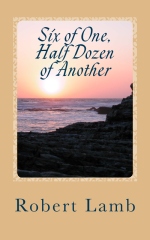
A Majority of One is about a clash between religion and the Constitution. A high school English teacher in a small Southern town gets into trouble when she resists the efforts of local preachers to ban some classic American novels from the classroom. Six of One, Half Dozen of Another contains stories and poems from a lifetime of writing, with an afterword on the origins of the pieces. Over the years, I've much enjoyed reading what authors said about their works and about writing in general. W. Somerset Maugham, among the best of storytellers, had a great deal to say about his works. Stephen King is the only modern writer I know who does it, but the Paris Review's author interviews are well-known for such discussions.


3. You’ve written several books and stories, some of which have nominated for awards. Is there any accolade that you find particularly memorable? Do you have a favourite among your books?

With my first novel, I had the same agent as Pat Conroy, Julian Bach. When Mr. Bach called me one day and said, "I loved your novel; it is a marvelous tale wondrously wrought," I nearly swooned. (In retrospect, though I believe that Striking Out was a very good first novel, I don't think it was that good; still that phone call meant a lot to me.) Among other accolades, I'm proud of being a winner of the South Carolina Fiction Project and of being named to the South Carolina Literary Map. But most of all, I like comments from readers -- the phone call or email from out of the blue that says, in effect, "Your work really moved me." As to a favorite among my books, I don't have one. Besides, one's books are in a way like one's children; even if you have a favorite child, it's unwise to let it be known. Your readers might find this interesting, though: when I reflect on what I've written, I think mostly in terms of scenes I've written, rather than complete stories or novels. I'm a tough critic of my writing, but here and there I've turned out a scene about which I was pleased to think: I can't write any better than that. That's particularly gratifying when I think of the scene here or there that I just never got right in spite of many rewrites.


4. As well as fiction, you also write non-fiction and poetry. Do you find it difficult to switch between these types of writing? And is there a different mindset for you when switching between them?

Perhaps oddly, I don't find writing fiction to require a very different mindset from non-fiction. In each, I'm trying to get it right, trying to make language do what I want it to do, which, among other things, is not only to be understood, but to be so clear that it can't be misunderstood. Poetry is a different animal altogether, too. After "teaching" poetry courses a few times, I concluded that poetry couldn't be taught, that I could only hold classes in it. Writing poetry is for me equally recondite. I rarely see a poem of mine coming, and even after it gets here I rarely know where it came from.


5. Do you have a particular process or a writing routine?

Besides the three novels I've published, I've written two others and am in the homestretch on the sixth. For my first published novel, I wrote every day from 8 a.m. to noon. I haven't been that disciplined on the others, but by nature I'm the kind of person who persists until a job is finished. For aspiring writers who read this, however, I recommend a book titled Structuring Your Novel, by Meredith and Fitzpatrick. It helped me enormously the first time around.


6. Why did you gravitate to writing in a more literary manner as opposed to choosing a niche genre such as mystery or science fiction?

Genres like mystery and science fiction are generally intended as diversionary reading, entertainment. The literary genre concerns itself with what is called the Human Condition: birth, youth, adolescence, courtship, marriage, procreation, old age, death – in other words, the real stuff of life. The two forms sometimes overlap, of course; The Wizard of Oz, though fantasy, obviously was written with a purpose more serious than merely entertainment. Same for Animal Farm. And for Fahrenheit 451 and for 1984. I've had a lifelong interest in human behavior and I've pursued a lifelong quest for meaning and understanding; these interests incline me toward serious fiction, though "serious" should not be construed as omitting humor. I guess basically I want to learn rather than be entertained – but since I enjoy learning I guess you could say I'm entertained by it. Bottom line: different strokes for different folks (but I've actually considered advertising my work as "guaranteed vampire-free.")


7. Are there any authors that profoundly influenced the way you write?

Who knows where influence begins and leaves off? But I'm conscious of trying only to get the best out of myself, which precludes imitating others. We learn from all, however, and I particularly like Hemingway's style, Maugham's storytelling, Hardy's novels.


8. You are also a book reviewer. Do you find being a writer gives you a helpful perspective in reviewing or makes it harder to be objective?

It definitely helps. The old adage "walk a mile in my shoes" comes in very handy in appraising, say, the adroitness of something that another writer has written. Having done both also gives me a heightened awareness, I think, of what another writer was trying to achieve. As an author, I've been positively floored by how bad a reviewer can be, and the badness is almost always rooted in ignorance and/or poor understanding of the craft of writing. I'd be tempted to vote for a law requiring all reviewers to have written at least 100 pages of their own work. A writer whose reviewer reviews the novel the writer actually wrote, instead of what the reviewer thinks he wrote, is a lucky author.


9. Do you have any upcoming projects?

Yes. In the spring I'll being out either of two novels: one that's finished or the one that's nearly finished. Then I will begin rewriting my very first novel, the one that wasn't good enough to find a publisher the first time around.

For more about Robert, you can visit his blog: http://bit.ly/rpQqht

And you can check out Robert's books here:

A Majority of One: A clash between religion and the Constitution in a small Southern town
http://amzn.to/tzBNcI

Six of One, Half Dozen of Another: Award-winning and groundbreaking short stories and poems
http://amzn.to/u4NEoo

Atlanta Blues: A reporter and two cops search for a missing coed; the search leads through the underbelly of urban Atlanta to murder and heartbreak
http://amzn.to/tx6NfY

Striking Out: A coming-of-age novel
http://amzn.to/t3sqU2

Ghosts: A longish short story about a teenage ghost hunt
http://bit.ly/oAIexY

Thursday, 8 September 2011

Interview with Kenneth Weene

Another author joins the blog today for an interview.   Kenneth Weene has stopped by to share his thoughts and to tell us about his books.

Interview With Kenneth Weene:


Why don’t you begin by sharing a little about yourself?

I’m a New Englander by birth and inclination even though I have lived most of my adult life in New York and now Arizona.
My undergraduate degree was in economics and my doctorate in psychology. (I’m also an ordained minister.) I practiced as a shrink for over thirty years, but now I principally identify myself as an author. I have two novels in print and a third in contract.
Married with one son and three grandchildren, I love travel, theatre, good food, and music.
No, I don’t like long walks on beaches, and I am now too old to be taking care of pets.


How long have you been writing?  Did you always desire to make it your line of work?
 
I wanted to write when I was a child, but I was brought up expecting to go into a profession. My mother always told me that my first name should be Doctor. When I had had enough of the helping profession and started thinking about retirement and life beyond, I began writing – poetry at first but then it just expanded.


Can you tell us about your writing style and your books?

I strive for literary fiction, which means that I craft words and characters rather than plots and actions. This doesn’t mean that my novels lack plot, only that the action is less important than how I tell the story and how fully-drawn the characters seem.
My first novel, Widow’s Walk is about relationships and love, about the conflict between religion and responsibility on the one hand and spirituality and sensuality on the other. This is a book that celebrates faith while questioning how people approach God.
Memoirs From the Asylum is primarily set in a state mental hospital. It is written to convey the power and the chaos of madness. Underlying the novel are questions about freedom and the fears and forces that keep us from being free. As more than one reviewer has pointed out, Memoirs is an existential novel. Many reviewers have also commented that it is better than One Flew Over the Cuckoo’s Nest; who am I to disagree?
Tales From the Dew Drop Inne: Because there’s one in every town will soon be released by my publisher, All Things That Matter Press. It is somewhat different in structure, being composed on interlocking stories all of which focus on the men and women who hang out at a neighbourhood bar, The Dew Drop Inne. Many of the stories have a bittersweet quality. This novel asks us to think about what are home and family.


You write poetry as well as fiction, something I do myself.  Do you prefer composing poetry to fiction or the opposite?

I write as the muse directs. In the middle of a novel, I might stop to work on an idea for a poem. It is the process of massaging words that matters. Here are two short poems that I particularly like sharing.

Dust
He coughs down his multi-hued pills with rancid brew
left day after day in an old unwashed carafe.
Decay is the status of things when life is through
as age prepares for death and final awkward laugh.
He pisses like a mule – rancid with years of sweat.
Too many empty bottles and whores he’s left;
opportunities that he’s missed without regret;
a lifetime of love and friendship long since bereft.

Early Breakfast
The worm - half eaten - burrows deeper
The robin’s beak is even fleeter.
Regrets the worm that he must eat her;
the apple makes her that much sweeter.


Can you tell us about your writing process?  Where do your ideas originate?  Do you have a certain writing routine?

Like most writers I draw on life as I have known and experienced it, but not always. The ideas often seem to be voices in my head demanding to be heard. While I usually spend an hour or so each morning at the keyboard, it is when those voices become most demanding that my fingers fly. At those times absorption becomes total, and my wife suffers my inattentiveness.


What is your greatest challenge as a writer?

I hate to answer this question honestly. The biggest challenge is getting readers. Marketing takes so much time and effort. Even when I enjoy doing an interview, a radio show, a signing, or a blog, I can’t help wishing that I had the time to create the next story or to work on that great poem.


What advice would you give beginning writers?

Write.
Find others who will listen to you read what you have written and give you honest feedback.
Rewrite.
Read what you have created and pick it apart.
Write again.
Now find an editor to check for the things you cannot see in your own eye.
A final rewrite, and you have something ready to offer to the world – wich will usually reject it.


Who has inspired you as a writer?

I have always read voraciously. Steinbeck and Vonnegut are among my favourites. Whitman, Thomas, Elliot, and Ferlinghetti in poetry. Goodness, so many.


What’s next for you?

I have a fourth novel, a conspiracy/coming of age book, which is currently looking for a publisher. I am taking a few weeks at The Writers’ Colony in Eureka Springs, Arkansas, to work on my next novel, of which about a third is done. It is very much a work of literary fiction, but it also has a science fiction component. I hope it will be finished by the end of 2012, at which time I can start the rewriting. Got to love the process!


You can find more about Kenneth at his website:  http://www.authorkenweene.com/

And for a taste of his books:

Widow’s Walk: 
http://vidego.multicastmedia.com/player.php?p=wbgzb2yk

For Memoirs From the Asylum:
http://vidego.multicastmedia.com/player.php?p=nqm74a8k


Sunday, 10 July 2011

A Step Back Into History: A Review of Wave of Terror

My Book Review of Wave of Terror by Theodore Odrach (translated by Erma Odrach):

Wave of Terror by Theodore Odrach (translated by Erma Odrach) is a quiet, vivid book that creeps up on you with a subtle, powerful voice. It is a small glimpse into a harsh past, but still shows the very human spirit that endures.

The novel tells the story of Ivan Kulik, a school master in the Pinsk Marshes, Belarus at the time of the Soviet takeover of that area. It chronicles his experiences and those of his friends and neighbours as the Soviet machine slowly invades and insidiously reorders their lives.

Wave of Terror is a literary novel, not my usual choice in a book, but I liked reading the rich story set against the backdrop of Soviet expansion. The characters are old-world, often quirky or outspoken and are the different voices for the underlying political narrative. The plotline is woven with the changing, brutal politics of the day, but the author and translator never overwhelm the human aspect. The characters lives continue, even when their neighbours disappear or are killed.

The book has an almost surreal aspect to it, which I think lends to the flavour of the reading experience and truly immerses the reader in the time period of the novel. And the ending is perfect, leaving you wondering and yet still having hope for Ivan.

A fabulous book that is a must read.


Also available at Amazon.ca

Subscribe Now:

Search This Blog

Powered By Blogger

Monthly Pageviews