Saturday, 31 December 2011

My Top Ten Favouite Reviewed Books of 2011

It's the end of the year, and time to reflect.  So I compiled a list of exceptional books that I read and reviewed on this blog in 2011:

 My Top Ten
  1. On Dark Shores: The Lady by JA Clement:  A lyrical fantasy novel and a brilliant read.
  2. Doodling by Jonathan Gould:  A quirky, charming bit of sci-fi and a finalist in the Goodreads Choice Awards.
  3. Refracted by Sheila Deeth: A sci-fi treasure of a read.
  4. Act of Will by M. Darusha Wehm:  The second in a series, this is a fantastic cyber crime thriller (I also got my hands on an ARC copy of the third book in this series, to be reviewed in March.  Yeah!)
  5. The Egyptian by Layton Green:  A wonderful and engrossing thriller
  6. Joe is Online by Chris Wimpress:  A fascinating and controversial apocalyptic book about the digital age.
  7. EboCloud by Rick Moss:  Another digital age book, this one a cyber mystery.
  8. The Empire by Elizabeth Lang:  An intriguing sci-fi novel, with a sprinkling of romance.  
  9. Die Laughing by Louis K. Lowy:  Another sci-fi book, this one with satire, comedians and aliens.
  10. Shadow of a Dead Star by Michael Shean:  Yet another cyber crime novel, witha heck of a twist ending.

Hmmm, after reading the list I think there may be a pattern in my reading habits.


And here are some honourable mentions:
  • Rabbit: Chasing Beth Rider by Ellen C. Maze: A Christian vampire novel 
  • Symphony of Blood by Adam Pepper:  A horror mystery 
  • End of Mae by Angela Yuriko Smith:  A fun paranormal  book
  • In My Mind’s Eye by Justin Marciano:  A wonderful memoir  

Monday, 19 December 2011

Interview with author Robert Lamb

Today the blog is going from geek to chic, with a visit from literary author Robert Lamb as he chats about his books and writing...


Interview with Robert Lamb


1. Why don’t you begin by sharing a bit about yourself and your writing?

I teach writing and American literature at the University of South Carolina, to which I came after a 20-year career in journalism, last with The Atlanta Constitution. I joined USC as a publications writer/editor, but was invited to teach after my first novel (Striking Out) was published and was nominated for the PEN/Hemingway Award. Been teaching ever since as an adjunct professor. I've been writing fiction since I was 10 years old, beginning when I was inspired by the movie "Gentlemen's Agreement," starring Gregory Peck as a magazine writer doing undercover expose on anti-semitism.


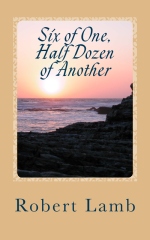
2. Would you please describe your latest books, A Majority of One and Six of One, Half Dozen of Another (Stories & Poems +1), for the readers?

A Majority of One is about a clash between religion and the Constitution. A high school English teacher in a small Southern town gets into trouble when she resists the efforts of local preachers to ban some classic American novels from the classroom. Six of One, Half Dozen of Another contains stories and poems from a lifetime of writing, with an afterword on the origins of the pieces. Over the years, I've much enjoyed reading what authors said about their works and about writing in general. W. Somerset Maugham, among the best of storytellers, had a great deal to say about his works. Stephen King is the only modern writer I know who does it, but the Paris Review's author interviews are well-known for such discussions.


3. You’ve written several books and stories, some of which have nominated for awards. Is there any accolade that you find particularly memorable? Do you have a favourite among your books?

With my first novel, I had the same agent as Pat Conroy, Julian Bach. When Mr. Bach called me one day and said, "I loved your novel; it is a marvelous tale wondrously wrought," I nearly swooned. (In retrospect, though I believe that Striking Out was a very good first novel, I don't think it was that good; still that phone call meant a lot to me.) Among other accolades, I'm proud of being a winner of the South Carolina Fiction Project and of being named to the South Carolina Literary Map. But most of all, I like comments from readers -- the phone call or email from out of the blue that says, in effect, "Your work really moved me." As to a favorite among my books, I don't have one. Besides, one's books are in a way like one's children; even if you have a favorite child, it's unwise to let it be known. Your readers might find this interesting, though: when I reflect on what I've written, I think mostly in terms of scenes I've written, rather than complete stories or novels. I'm a tough critic of my writing, but here and there I've turned out a scene about which I was pleased to think: I can't write any better than that. That's particularly gratifying when I think of the scene here or there that I just never got right in spite of many rewrites.


4. As well as fiction, you also write non-fiction and poetry. Do you find it difficult to switch between these types of writing? And is there a different mindset for you when switching between them?

Perhaps oddly, I don't find writing fiction to require a very different mindset from non-fiction. In each, I'm trying to get it right, trying to make language do what I want it to do, which, among other things, is not only to be understood, but to be so clear that it can't be misunderstood. Poetry is a different animal altogether, too. After "teaching" poetry courses a few times, I concluded that poetry couldn't be taught, that I could only hold classes in it. Writing poetry is for me equally recondite. I rarely see a poem of mine coming, and even after it gets here I rarely know where it came from.


5. Do you have a particular process or a writing routine?

Besides the three novels I've published, I've written two others and am in the homestretch on the sixth. For my first published novel, I wrote every day from 8 a.m. to noon. I haven't been that disciplined on the others, but by nature I'm the kind of person who persists until a job is finished. For aspiring writers who read this, however, I recommend a book titled Structuring Your Novel, by Meredith and Fitzpatrick. It helped me enormously the first time around.


6. Why did you gravitate to writing in a more literary manner as opposed to choosing a niche genre such as mystery or science fiction?

Genres like mystery and science fiction are generally intended as diversionary reading, entertainment. The literary genre concerns itself with what is called the Human Condition: birth, youth, adolescence, courtship, marriage, procreation, old age, death – in other words, the real stuff of life. The two forms sometimes overlap, of course; The Wizard of Oz, though fantasy, obviously was written with a purpose more serious than merely entertainment. Same for Animal Farm. And for Fahrenheit 451 and for 1984. I've had a lifelong interest in human behavior and I've pursued a lifelong quest for meaning and understanding; these interests incline me toward serious fiction, though "serious" should not be construed as omitting humor. I guess basically I want to learn rather than be entertained – but since I enjoy learning I guess you could say I'm entertained by it. Bottom line: different strokes for different folks (but I've actually considered advertising my work as "guaranteed vampire-free.")


7. Are there any authors that profoundly influenced the way you write?

Who knows where influence begins and leaves off? But I'm conscious of trying only to get the best out of myself, which precludes imitating others. We learn from all, however, and I particularly like Hemingway's style, Maugham's storytelling, Hardy's novels.


8. You are also a book reviewer. Do you find being a writer gives you a helpful perspective in reviewing or makes it harder to be objective?

It definitely helps. The old adage "walk a mile in my shoes" comes in very handy in appraising, say, the adroitness of something that another writer has written. Having done both also gives me a heightened awareness, I think, of what another writer was trying to achieve. As an author, I've been positively floored by how bad a reviewer can be, and the badness is almost always rooted in ignorance and/or poor understanding of the craft of writing. I'd be tempted to vote for a law requiring all reviewers to have written at least 100 pages of their own work. A writer whose reviewer reviews the novel the writer actually wrote, instead of what the reviewer thinks he wrote, is a lucky author.


9. Do you have any upcoming projects?

Yes. In the spring I'll being out either of two novels: one that's finished or the one that's nearly finished. Then I will begin rewriting my very first novel, the one that wasn't good enough to find a publisher the first time around.

For more about Robert, you can visit his blog: http://bit.ly/rpQqht

And you can check out Robert's books here:

A Majority of One: A clash between religion and the Constitution in a small Southern town
http://amzn.to/tzBNcI

Six of One, Half Dozen of Another: Award-winning and groundbreaking short stories and poems
http://amzn.to/u4NEoo

Atlanta Blues: A reporter and two cops search for a missing coed; the search leads through the underbelly of urban Atlanta to murder and heartbreak
http://amzn.to/tx6NfY

Striking Out: A coming-of-age novel
http://amzn.to/t3sqU2

Ghosts: A longish short story about a teenage ghost hunt
http://bit.ly/oAIexY

Saturday, 17 December 2011

The Pages of War and Love: A Review of The Art of War: a Novel

My Book Review of The Art of War: a Novel by Angela Panayotopulos:


The Art of War: a Novel by Angela Panayotopulos is an extraordinarily compelling novel, written with an almost surreal style. It is a panoramic mosaic of vignettes erupting in shades of love, war and family

The novel is set on the small Greek island of Mythaki, over a period of years before and during WWII. We see events unfold mostly through the eyes of a brother and sister, Kalli and Gabe, first their idyllic simple island life and then the bitter and tragic transformations wrought by the war.

The author paints her canvas of words vividly, her backdrop of war palpable and stark. But it is her characters, the atmosphere and the small details that breathe a subtle and pulsating life into the book. It is a poignant, warm, amusing and sometimes brutal portrait of a piece of history frozen in time. I also like the unusual feel of the book, that the structure and ambience gives a slightly unreal touch to the story. I think it adds to both the portrayal of Greek island culture and the hollow reality of a warzone. By the end of the book I felt as if I knew both the island of Mythaki and its people personally.

I did notice that the author left a few characters dangling in oblivion, but in a way it also reflected the unpredictability of warfare, so I didn’t find it distracted excessively from the storyline. Overall I enjoyed this book immensely and highly recommend it.

Monday, 12 December 2011

Tardy with an Award

A few weeks ago, (almost a month ago actually), my blog had another award bestowed upon it, the Liebster Blog Award given by the talented Angela Yuriko Smith and her wonderful blog Dandilyon Fluff.  Between writing, reviewing and general forgetfulness, I neglected to post about it until now. But better late than never I suppose.

So here it is:

“The Liebster Blog Award started in Germany and was intended to drive traffic to hidden gems.” Liebster is German for “friend”. The rules are simple:

1. Thank the giver and link back to the blogger who gave it to you.
2. Reveal your top blogger friends and let them know by leaving a comment on their blog.
3. Copy and paste the award on your blog.

My top blogger friends (besides Angela) are:

Pat Bertram (who has so many blogs I’ve lost count). Check out her main one at: http://ptbertram.wordpress.com/

Joylene Nowell Butler, a wonderful writer with an insightful and helpful blog: http://cluculzwriter.blogspot.com/

Sheila Deeth, an exquisite writer who also does great book reviews: http://sheiladeeth.blogspot.com/

Rhetta Akamatsu, who writes about blues music, ghosts and the paranormal and steampunk: http://rhetta.wordpress.com/

And all the bloggers over at Murder by 4. There is always something interesting brewing at that blog: http://murderby4.blogspot.com/

Check them out, you won’t be sorry.

Saturday, 10 December 2011

Interview wth author Ray Wallace

Another guest today, as author Ray Wallace stops by to chat about horror, zombies and writing:


Interview with Ray Wallace


1. Why don’t you begin by sharing a little about yourself.

I grew up in the Pittsburgh, PA area. Moved to the Tampa, FL area after my junior year in high school. Developed a passion for reading all things fantastic (fantasy, SF, horror) when I was in my early teens. Was in a few metal bands and industrial music projects throughout my twenties. And, now, here I am dedicating most of my free time to writing my crazy little dark fiction stories.


2. Can you tell us about your latest book, Escape From Zombie City?

I actually wrote a big chunk of it for NaNoWriMo (National Novel Writing Month) a couple years ago. Lots of Zombies. Lots of insanity. Lots of dying. The perfect stocking stuffer, really.


3. Escape From Zombie City is written in the style of a “Choose Your Own Adventure” book. Can you tell us why you decided to write it in that format?

I really enjoyed those books when I was a kid. I think it’s always been in the back of my mind to write a CYOA book at some point. But I wanted to do something a little different with it. Thus, the One Way Out idea, where only one pathway leads to your survival. Placing the reader in the midst of a zombie outbreak just seemed like a natural fit. I really enjoyed writing it and have been developing a few other One Way Out ideas.


4. Why did you decide to write in the horror genre?

Well, of course, I enjoy the horror genre a great deal. A lot of my favorite writers are horror writers--King, Barker, Lansdale, etc. I think horror writing is the most liberating form of writing. You can do pretty much anything in a horror story. Let all those nasty little thoughts always bumping around inside your skull loose on the world. It’s a lot of fun, really. And a lot cheaper than therapy. Everyone should try it.


5. Can you tell us about your writing process? Where do your ideas originate? Do you have a certain writing routine?

Whenever I have some free time and the urge hits me, that’s usually when I get my writing done. There’s no real process or routine. I’ve always been terribly unorganized. I keep telling myself that I’ll get better at managing my time some day but I’ve been telling myself that for a long time so we’ll see. As far as where I get my ideas... I think when you read enough, write enough, immerse yourself in what you’re doing enough, the ideas just seem to happen. And it’s always cool when it does happen, when a particularly interesting idea pops into your head. That’s the magic moment of doing anything artistic.


6. What is your greatest challenge as a horror writer?

Trying to do something a little different. Trying to not fall into all the old cliches. Because there is definitely no shortage of cliches in the horror field.


7. What sort of research do you do for your books?

Any research required for my stories is usually done on the internet. And it usually involves the small things, getting the details right. If a character’s wielding a gun it means reading up on makes and models of handguns, what sorts of ammunition they use. Looking up floor plans for different types of buildings. Checking out maps of cities or towns to get a better sense of the fictional city or town in which my characters interact. That sort of thing. Haven’t had to do the levels of research it would take to write a historical thriller although I’d like to give it a whirl one day.


8. What advice would you give writers thinking of writing horror or paranormal fiction?

The usual, I suppose. Read a lot of horror fiction but also read a lot of other types of fiction. You never know where that great idea will come from or what style might influence you. And write a lot. That should go without saying.


9. Who has inspired you as an author?

Wow, there are just too many to name. King and Barker, of course. And I love Joe Lansdale’s writing. Chuck Palahniuk. Skipp and Spector. Ed Lee. Poppy Z. Brite. Charlee Jacob. I could go on and on. There are a number of sci-fi and fantasy authors who have inspired me too: China Mieville. Stephen R. Donaldson. Frank Herbert. William Gibson. It’s a terribly long list. There are a number of bizarro writers I enjoy reading too.


10. What’s next for you?

THE HELL SEASON will be released by Severed Press here in the near future. I’m also editing a collection of my short fiction which I hope to have out in the next month or two. Putting the finishing touches on a novel called A MAN POSSESSED and hopping around between a few other projects. The fun just never ends.


Ray Wallace hails from the Tampa, FL area and is the author of THE NAMELESS (Black Death Books), ESCAPE FROM ZOMBIE CITY: A ONE WAY OUT NOVEL (The Zombie Feed Press), and THE HELL SEASON (coming soon from Severed Press). More than two dozen of his short stories have appeared in such magazines and anthologies as THE ZOMBIE FEED: VOL. 1, THE BLACKEST DEATH: VOL. 1 & 2, and EROTIC FANTASY: TALES OF THE PARANORMAL. A few of his other stories have appeared at THE CHIAROSCURO website where he took first place in their second annual fiction contest. He also wrote a long running book review column for THE TWILIGHT SHOWCASE webzine and now writes reviews for CHIZINE and SFREADER.COM.


Subscribe Now:

Search This Blog

Powered By Blogger

Monthly Pageviews