Showing posts with label military. Show all posts

Friday, 13 September 2019

Book Review: Shields in Shadow

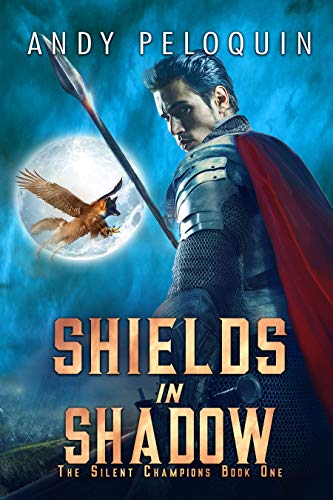
Today I have a book review of the new military fantasy, Shields in Shadow (The Silent Champions #1) by Andy Peloquin. Enjoy.


A Review of Shields in Shadow (The Silent Champions #1)


Shields in Shadow
is a well-crafted military fantasy that does not disappoint.
The book begins with a big action-packed battle scene which sets up the Roman-style legion army, their enemies and the tone of the book. One of the battle survivors, Aravon, is recruited into a covert ops company and the story evolves from there.
I loved this novel. The pacing is more deliberate and slower than some of the author’s previous novels, but it works well for this book as it builds layers onto itself which pay off in the later chapters.
The characters are top notch with their development happening with a nice subtle touch which I appreciated. Their interaction is believable, and the trust of their team gradual and solidly written.
I was also impressed with the battle scenes as they are well crafted as to strategy and accuracy in regard to their real-world counterparts. You still have some fantasy elements, but nothing distracting or eye-rolling and grounded in realism. I especially liked the special armour colours and the nod to the different types of metals and weaponry. The superior quality of some of the blades reminded me of the legendary Damascus steel.

Overall, I give the book first rate marks and highly recommend it.


You can find the book on:


Shields in Shadow (The Silent Champions #1)


Burdened with legend. Hardened by battle scars. Hellbent on bloody revenge. As the son of a famous general, Aravon is proud to captain his own company against his people's enemy. But the experienced veteran’s march toward glory dissolves into pain as ruthless barbarians massacre every last one of his soldiers. Burning for vengeance, he leaps at the chance to spearhead a specially-trained company and pay back his tragic defeat with blood. Desperate to not repeat his tragic past, Aravon trains his new warriors relentlessly. But the captain fears that all the tactical drills in the world may not matter when they’re forced to defend a helpless village against overwhelming odds. As his quick raids sow chaos amongst the enemy, the bloodthirsty savages threaten to make Aravon's nightmarish history repeat itself… Can the captain take command of his fighting spirit before the kingdom falls to barbarous invaders?

Friday, 26 October 2018

Halloween Week Book Spotlight: Wolves In The Desert


Today, I have a treat with werewolves in the spotlight. I'm featuring a new release, Wolves In The Desert, another prequel story for Timothy Bateson's Shadows over Seattle: Prequels series. Enjoy.


Wolves In The Desert by Timothy Bateson 


When his squad is deployed to Iraq, Gunnery Sergeant Garfield Feldman leads them in a series of operations against forces loyal to Saddam Hussein. 
Recently rumors have been flying around base that the enemy has learned a few new tricks, and found ways to ambush Marine units from buildings that had been declared clear. 
Now Feldman's team has received orders to conduct a snatch-and-grab mission deep in enemy-held territory. But what lies behind the walls, and what can Feldman do to ensure the success of the mission?

Available At


Book Webpage

Series Link


Author Bio


Timothy Bateson is a writer who broke into the market in 2014, with three short stories being featured in Halloween and science-fiction anthologies. In 2016, Bateson self-published a re-release of “Under A Hunter’s Moon”, the first of several stories set in the “Shadows Over Seattle” world, which he co-writes with his wife, Sandi.
Bateson is also a blogger who often spotlights books and fellow indie authors, alongside his other interests, such as the Brain to Books Cyber Convention events, falconry, journaling, quotes, and reading.    

Author Links

Tuesday, 20 June 2017

Interview with Author Bailey Ordiway

Today I have an excellent interview with multi-genre author Bailey Ordiway, who chats about his writing and his books. Enjoy.


Interview with Bailey Ordiway


Why don’t you begin by sharing a little about yourself.

I was born in Michigan and spent a great deal of my life there. I grew up on farms and in small towns, going to small schools. After I dropped out of high school I got my GED and went to college. My major changed a dozen times throughout, but, it was a great experience. After that I joined the Army, that was cut short very quickly though. I'm now married and live in South Dakota where I own my own business and write daily.


Could you tell us a bit about your latest book?
American Holdovers is my third published novel and chronicles not only my time, but, also my many friends and fellow holdovers during our time as a holdover at Ft. Jackson during a hurricane and the consequences and events that transpired because of this a couple years back.


You write in several genres. Do you have a favourite? And if so, why?

I actually don't, no. I try to write in multiple genres to not get stuck in a niche and expand my writing horizons. I'd also like to have something for everyone.


Why did you write this book? What was your inspiration?

Well I thought that it was a story that needed to be told. Not very many people know that holdovers are even a thing, and it's wildly undocumented. On top of that I believed it was a good story, a series of unfortunate events occurred one after another that just makes for a good read.


What did you enjoy most about writing your book?

It was nice to relieve some of the better experiences I had with my friends and keep the experience alive for us all.


When did you realize you wanted to be a writer?

I've wanted to be a writer since I was very young. I would always look at my mothers bookshelf as a child and just think "one day I will have my name up there".


Can you tell us about your writing process? Where do your ideas originate? Do you have a certain writing routine?

I find it difficult to focus. So, because of that everything I write is meticulously outlined. Before I ever even open a word document I fill up multiple binders on my book. Everything from minor characters to a step by step progression of each chapter. When I do eventually write however I sit at the same desk, listen to the same music, drink the same coffee, and light the same candle.


Do you have a favourite author, or writing inspiration?

John Green is by far my favorite author. Being a fan of his is rather torturous though since he releases a book about every five years at this point.


Are you working on another book?

I will be, soon. I have been working on this one for nearly two years now though and would like to focus a bit on my blog. I enjoy writing movie reviews and it has gone to the back burner a bit while writing this book.


You can find Bailey Ordiway's latest book, American Holdovers, on Amazon.

And you can check out the rest of his books at his Amazon page.


For more on the author check out these sites.


Wednesday, 31 July 2013

Interview with Martin Roy Hill

Another interview today, this time with Martin Hill, author of the military thriller, The Killing Depths.


Interview with Martin Roy Hill 


Why don’t you begin by sharing a little about yourself?

Well, I’m a very rare native Californian, born and reared in Southern California and, other than my military service, I've always lived here. I worked as a journalist for twenty years, starting as a police reporter for a daily newspaper, then as an investigative reporter for a magazine, and ending as the editor of a business newspaper. I got tired of journalism and switched careers, becoming a military research analyst in the field of combat medicine. I've been a medic of one sort or another in both the military and in law enforcement reserves, as well as on a disaster response team, so that was a pretty natural transition. I live in San Diego, with my wife, Winke, our son, Brandon, and our two feline masters, Harry and Alex, whom we serve and obey.

How long have you been writing, and how many books have you published to date?

I became interested in writing in high school thanks to an English teacher who encouraged me to read classics and develop my writing skills. That’s when I started studying journalism and fiction writing. Over the years I've continued to write both nonfiction, both as a staffer and as a freelancer, and fiction. I've had nonfiction pieces published by LIFE, Newsweek, Reader’s Digest, Omni, and other magazines. My short fiction has appeared in Alfred Hitchcock Mystery Magazine, Plan B Mystery Anthology, San Diego Magazine and others. So far, I have two books published, DUTY: Suspense and Mystery Stories from the Cold War and Beyond, and The Killing Depths.

Can you tell us about your books?

DUTY is a collection of previously published and new short stories which share a common thread dealing with military service. In the title story, an American soldier in the Cold War is ordered to do the unthinkable—start World War III. In another story, “Something Far Away,” a former Coastguardsman has to face the ghosts of his past as he helps smuggle a boatload of marijuana ashore. “The Stragglers” examines the impact wars have had on several generations of soldiers. In “The Use of Innocence,” a Vietnam vet tries to understand why a younger generation of soldiers is so eager to fight another war.
My novel, The Killing Depths, is a military mystery thriller which features NCIS Agent Linus Schag, who also appears in one of the short stories in DUTY.  Schag is sent aboard the USS Encinitas, the first American attack sub manned by both men and women, to investigate the apparent suicide of a female sailor. He soon discovers the death was not only murder, but also the work of a serial killer who’s left a trail of dead women on shore. At the same time, the Encinitas is ordered on a covert mission to intercept and destroy a renegade Iranian sub armed with nuclear missiles. As the American crew engages in a life-or-death battle with the Iranian, Schag struggles to find the identity of the serial killer before the murderer’s blood lust destroys the Encinitas itself.
DUTY, by the way, was recently named the 2013 Best Short Story Anthology/Collection by the San Diego Book Awards, and The Killing Depths was a finalist for the 2013 San Diego Book Awards Sisters In Crime Mystery Award.

Why did you decide to write thrillers, military thrillers in particular?

I’m not sure I am just a thriller writer. The story line determines if it will be a thriller. There are stories in DUTY that are suspenseful and have the elements of thrillers, but others are more or less straight mysteries.
Writing military-related stories comes naturally, as I have served in the Coast Guard, Navy and a component of the California National Guard, and I now work for the Navy as an analyst. But sometimes the military aspect is tangential to the plot. The murder mystery I have coming out later this year doesn't involve the military; however, the protagonist is a war-weary war correspondent. The book I’m currently writing on is a sci-fi novella, but it involves American soldiers who make a startling discovery while serving in Iraq.

Can you tell us about your writing process?  Where do your ideas originate?  Do you have a certain writing routine?

I get my ideas from a variety of sources. From newspapers, from history books, even my friends. The short story “Duty,” for instance, was inspired by a friend’s experience when he was ordered to Vietnam. He was a nuclear demolitions specialist, and he thought the only reason he was being sent to Nam was to take the war to the nuclear brink. Of course, it turned out to be for other reasons.
“Something Far Away” was inspired by a true incident I heard about when I reported to my first duty station in the Coast Guard involving a fellow Coastie with PTSD.
Unfortunately, my writing schedule is inconsistent. I can only write part-time, since I have to work to pay the rent and put food on the table. I try to squeeze in an hour a day, or about 500 words, and more on the weekends, but I don’t always succeed. I recently purchased a Kindle Fire and a Bluetooth keyboard that I keep in my backpack. If I get a few minutes here or there, I can whip them out and write a few words.

How do you research your books?

With my background as a journalist and research analyst, researching my books comes pretty naturally. Researching The Killing Depths was a challenge, though. After all, submariners aren't called the Silent Service for nothing. I read a lot about submarine warfare and technology, studied schematics of Los Angeles-class submarines, and talked to former submariners. I really scored big when the Navy agreed to give me a tour of a Los Angeles-class sub.
I also had to research the psychology of serial killers in order to get into the head of the antagonist. I read several papers on the subject, which eventually made me completely change the backstory I had planned for the serial killer.

You've also worked as a journalist. Was it difficult to transition into writing fiction? What is your greatest challenge as a fiction writer?

I never had to make a transition. I wrote fiction the entire time I was worked as a journalist. I also worked for both newspapers and magazines, and each of those requires a different style of writing. As a result, switching from one form of writing to another isn't that difficult for me.
However, the one thing I really took away from my journalism career is an appreciation for good editing. I've known good editors and really rotten editors. Fortunately, my wife, Winke, is a highly experienced editor and edits everything I write.
I think my greatest challenge as a fiction writer is not giving up. I went a long stretch without writing anything, mostly because we were involved in two wars and the op tempo at my Navy job was very high. But I also think I didn't write because I was disillusioned.  I had had some bad experiences with three incompetent literary agencies, and I started feeling hopeless. I had to get away from that before I could start writing again. Fortunately, I discovered indie publishing and I can stay away from lit agencies.

Who has inspired you as an author?

In my personal life, I was inspired by my high school English teacher, as I said earlier. I was also inspired by my late father-in-law, Robert Wade, who wrote twenty or thirty mysteries under the pen names Wade Miller and Whit Masterson, as well as under his own name. If you've ever seen the Orson Wells film noir classic, “Touch of Evil,” that was based on one of Bob’s books.
As far as being influenced by other writers, there are too many to name. I’m a prolific reader of many genres of fiction – mysteries, thrillers, sci-fi – and I learn something most everything I read.

What’s next for you?

My next book, Empty Places, is a murder mystery set in the California desert in the mid-1980s. Peter Brandt, a war correspondent, returns to the desert resort of Palm Springs to attend his ex-wife’s funeral only to learn she’d been brutally murdered and he’s the next target of her killer or killers. In trying to solve his ex-wife’s murder, Brandt uncovers a hornet’s nest of anti-communist rebels, smugglers, pornographers, and child sex slaves. It’s quasi-historical, in that it’s a microcosmic look at what was actually going on in the country during that period. Empty Places should be out before the end of the year.

Links for Martin Hill:

Martin's books are available on Amazon 


Saturday, 29 September 2012

Interview with Philip Sharp, Author of Not in the Wind, Earthquake, or Fire

Today brings another interview, this time with writer and retired soldier Philip Sharp, who chats about his writing and his book, a non-fiction account of his tour of duty in Iraq.


Interview with Philip Sharp


Why don’t you begin by telling my readers a bit about yourself?

I was born in Elkins, WV and moved around quite a bit between there and Florida while growing up. I graduated from Apopka High School in 1990 and immediately left for the Army. In the Army I served as an Infantry soldier for 20 years where I graduated from Ranger School, completed 22 parachute jumps, and served as a Drill Sergeant. I have been to a variety of locations to include South Korea and Panama and deployed to Iraq on three separate occasions. Recently, I retired in July of this year from active duty service. Currently I am creating an all-natural farm and serving in church ministries.


Your book, Not in the Wind, Earthquake, or Fire, is historical non-fiction, an account of your second tour in Iraq from 2006 to 2007. Can you tell us how you came to write it?

Most of it was written while I was there and did not realize it at the time. I kept a journal while I was deployed throughout most of it. About a year after I returned I began to write a book to give an account from a combat soldier’s view, one that seemed to be missing at the time. At first I wrote from memory and by talking with others, but always went back to the journal to guide me. I then decided to put the journal in the book and write around it.


You served for 20 years in the US Army Infantry. Other than providing the subject matter for your book, how do you think those experiences influenced you as a writer and in the creation of your book?

Good question. I wanted this book to be from the view of an Infantry soldier. Experiencing these events as one, I believe, gives a far different outlook than you would otherwise see. The influence of my service certainly affected what and how I wrote.


What would you like people to experience from reading your book?

I would like for readers to feel, not just see, a glimpse of what combat soldiers endured in their daily lives in Iraq. It provides the experience from the best source, a first-hand account from someone on the ground. Readers will see triumphs and victories, sorrows and defeats, and an in-depth look at holding on to hope when none is easily given. Readers will get an honest and non-glossed version of the war, a recounting of its costs, and an appeal to see God in our circumstances. 


In the process of writing your book, were there any surprises, revelations or things you didn’t expect?

Oh yes! First off, it took longer than I expected. It was half written in the first place, because of the journal. It took three long years though. As I would read through my journal again it was like reliving the deployment all over again. At times I had to force my way through it. Also getting the book published was an education in itself. I paid my fair share of the fool’s tax in the process. 


You’ve also published articles and war game simulations for Strategy & Tactics magazine as well as written a column for Modern War magazine. Did you find the change from writing short articles to a book length manuscript difficult?

Writing a lengthy book is certainly more of a challenge. It is even more challenging when you are emotionally attached to the subject matter. There is certainly more editing involved and constant revisions. Formatting issues, in itself, are enough to dishearten the faint of heart. 


Now that you have written a book of non-fiction, would you ever consider writing a novel? Possibly a military thriller?

It is a possibility indeed. I have no inspirations as of yet, but could certainly use my experiences to come up with a tangible and realistic type thriller in the future.


What are some of the things you like to do when not writing?

I love tending to my plants, animals, and doing work around my place.


What are your future writing plans? Will there be more books from you?

Presently, I still write for Modern War magazine. There will probably be more books in the future, though they all may not be military in nature. I would like to write one on the basics of managing a small farm based on more natural principles. There is also desire in me to write on tactics and the training of Infantry soldiers in hopes that others will learn from our experiences, both positive and negative, and ensure our soldiers and leaders are prepared for future conflicts.


About the Author:

Philip Sharp has served for 20 years in the US Army Infantry during which he graduated from Ranger School, completed 22 parachute jumps, and served as a Drill Sergeant. He has worked in a variety of locations to include South Korea and the jungles of Panama. He deployed to Iraq three separate times from 2003 until 2010. He has published articles and war game simulations in Strategy & Tactics magazine and currently is a contributing columnist for Modern War magazine. Philip is retired from active duty service and now lives in West Virginia with his wife Heather and four children were they are creating an all-natural farm and serving in church ministries.

You can find out more about Philip and his book here:


Subscribe Now:

Search This Blog

Powered By Blogger

Monthly Pageviews