Wednesday, 31 July 2013

Interview with Martin Roy Hill

Another interview today, this time with Martin Hill, author of the military thriller, The Killing Depths.


Interview with Martin Roy Hill 


Why don’t you begin by sharing a little about yourself?

Well, I’m a very rare native Californian, born and reared in Southern California and, other than my military service, I've always lived here. I worked as a journalist for twenty years, starting as a police reporter for a daily newspaper, then as an investigative reporter for a magazine, and ending as the editor of a business newspaper. I got tired of journalism and switched careers, becoming a military research analyst in the field of combat medicine. I've been a medic of one sort or another in both the military and in law enforcement reserves, as well as on a disaster response team, so that was a pretty natural transition. I live in San Diego, with my wife, Winke, our son, Brandon, and our two feline masters, Harry and Alex, whom we serve and obey.

How long have you been writing, and how many books have you published to date?

I became interested in writing in high school thanks to an English teacher who encouraged me to read classics and develop my writing skills. That’s when I started studying journalism and fiction writing. Over the years I've continued to write both nonfiction, both as a staffer and as a freelancer, and fiction. I've had nonfiction pieces published by LIFE, Newsweek, Reader’s Digest, Omni, and other magazines. My short fiction has appeared in Alfred Hitchcock Mystery Magazine, Plan B Mystery Anthology, San Diego Magazine and others. So far, I have two books published, DUTY: Suspense and Mystery Stories from the Cold War and Beyond, and The Killing Depths.

Can you tell us about your books?

DUTY is a collection of previously published and new short stories which share a common thread dealing with military service. In the title story, an American soldier in the Cold War is ordered to do the unthinkable—start World War III. In another story, “Something Far Away,” a former Coastguardsman has to face the ghosts of his past as he helps smuggle a boatload of marijuana ashore. “The Stragglers” examines the impact wars have had on several generations of soldiers. In “The Use of Innocence,” a Vietnam vet tries to understand why a younger generation of soldiers is so eager to fight another war.
My novel, The Killing Depths, is a military mystery thriller which features NCIS Agent Linus Schag, who also appears in one of the short stories in DUTY.  Schag is sent aboard the USS Encinitas, the first American attack sub manned by both men and women, to investigate the apparent suicide of a female sailor. He soon discovers the death was not only murder, but also the work of a serial killer who’s left a trail of dead women on shore. At the same time, the Encinitas is ordered on a covert mission to intercept and destroy a renegade Iranian sub armed with nuclear missiles. As the American crew engages in a life-or-death battle with the Iranian, Schag struggles to find the identity of the serial killer before the murderer’s blood lust destroys the Encinitas itself.
DUTY, by the way, was recently named the 2013 Best Short Story Anthology/Collection by the San Diego Book Awards, and The Killing Depths was a finalist for the 2013 San Diego Book Awards Sisters In Crime Mystery Award.

Why did you decide to write thrillers, military thrillers in particular?

I’m not sure I am just a thriller writer. The story line determines if it will be a thriller. There are stories in DUTY that are suspenseful and have the elements of thrillers, but others are more or less straight mysteries.
Writing military-related stories comes naturally, as I have served in the Coast Guard, Navy and a component of the California National Guard, and I now work for the Navy as an analyst. But sometimes the military aspect is tangential to the plot. The murder mystery I have coming out later this year doesn't involve the military; however, the protagonist is a war-weary war correspondent. The book I’m currently writing on is a sci-fi novella, but it involves American soldiers who make a startling discovery while serving in Iraq.

Can you tell us about your writing process?  Where do your ideas originate?  Do you have a certain writing routine?

I get my ideas from a variety of sources. From newspapers, from history books, even my friends. The short story “Duty,” for instance, was inspired by a friend’s experience when he was ordered to Vietnam. He was a nuclear demolitions specialist, and he thought the only reason he was being sent to Nam was to take the war to the nuclear brink. Of course, it turned out to be for other reasons.
“Something Far Away” was inspired by a true incident I heard about when I reported to my first duty station in the Coast Guard involving a fellow Coastie with PTSD.
Unfortunately, my writing schedule is inconsistent. I can only write part-time, since I have to work to pay the rent and put food on the table. I try to squeeze in an hour a day, or about 500 words, and more on the weekends, but I don’t always succeed. I recently purchased a Kindle Fire and a Bluetooth keyboard that I keep in my backpack. If I get a few minutes here or there, I can whip them out and write a few words.

How do you research your books?

With my background as a journalist and research analyst, researching my books comes pretty naturally. Researching The Killing Depths was a challenge, though. After all, submariners aren't called the Silent Service for nothing. I read a lot about submarine warfare and technology, studied schematics of Los Angeles-class submarines, and talked to former submariners. I really scored big when the Navy agreed to give me a tour of a Los Angeles-class sub.
I also had to research the psychology of serial killers in order to get into the head of the antagonist. I read several papers on the subject, which eventually made me completely change the backstory I had planned for the serial killer.

You've also worked as a journalist. Was it difficult to transition into writing fiction? What is your greatest challenge as a fiction writer?

I never had to make a transition. I wrote fiction the entire time I was worked as a journalist. I also worked for both newspapers and magazines, and each of those requires a different style of writing. As a result, switching from one form of writing to another isn't that difficult for me.
However, the one thing I really took away from my journalism career is an appreciation for good editing. I've known good editors and really rotten editors. Fortunately, my wife, Winke, is a highly experienced editor and edits everything I write.
I think my greatest challenge as a fiction writer is not giving up. I went a long stretch without writing anything, mostly because we were involved in two wars and the op tempo at my Navy job was very high. But I also think I didn't write because I was disillusioned.  I had had some bad experiences with three incompetent literary agencies, and I started feeling hopeless. I had to get away from that before I could start writing again. Fortunately, I discovered indie publishing and I can stay away from lit agencies.

Who has inspired you as an author?

In my personal life, I was inspired by my high school English teacher, as I said earlier. I was also inspired by my late father-in-law, Robert Wade, who wrote twenty or thirty mysteries under the pen names Wade Miller and Whit Masterson, as well as under his own name. If you've ever seen the Orson Wells film noir classic, “Touch of Evil,” that was based on one of Bob’s books.
As far as being influenced by other writers, there are too many to name. I’m a prolific reader of many genres of fiction – mysteries, thrillers, sci-fi – and I learn something most everything I read.

What’s next for you?

My next book, Empty Places, is a murder mystery set in the California desert in the mid-1980s. Peter Brandt, a war correspondent, returns to the desert resort of Palm Springs to attend his ex-wife’s funeral only to learn she’d been brutally murdered and he’s the next target of her killer or killers. In trying to solve his ex-wife’s murder, Brandt uncovers a hornet’s nest of anti-communist rebels, smugglers, pornographers, and child sex slaves. It’s quasi-historical, in that it’s a microcosmic look at what was actually going on in the country during that period. Empty Places should be out before the end of the year.

Links for Martin Hill:

Martin's books are available on Amazon 


Monday, 29 July 2013

Interview With Author Steve Schmutz

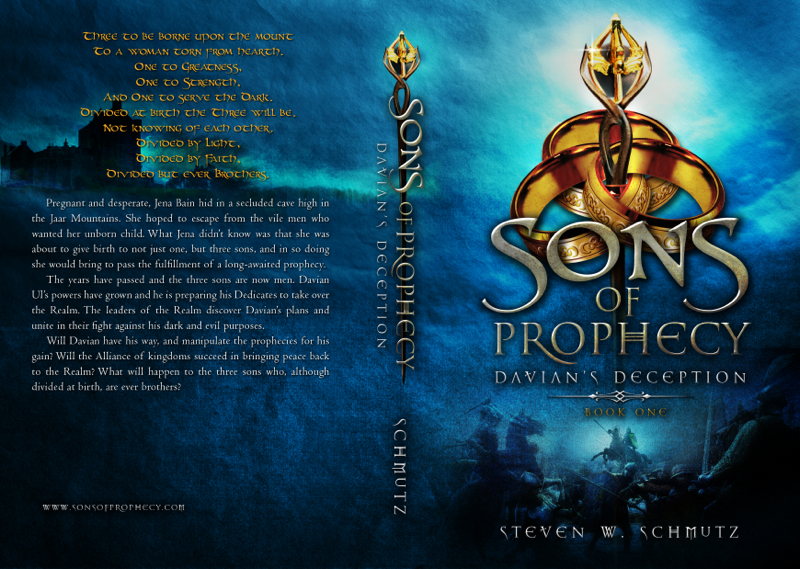
Today I have an interview for everyone, with Steve Schmutz author of Sons of Prophecy: Davian's Deception.


Interview with Steve Schmutz


Why don’t you begin by sharing a little about yourself. 

I grew up in Orem, Utah. As a youngster, I was active in sports like soccer and baseball. After high school, I served a two-year mission for my church in Honduras, then enrolled at BYU where I received a bachelor’s degree in business. I married my best friend in 1983. We have five daughters who have blessed us with 11 grandchildren, with the 12th on the way. I’m a software entrepreneur specializing in the claim and risk management industry. We live in a suburb of Salt Lake City, Utah.

Can you tell us a bit about your book, Sons of Prophecy: Davian's Deception?

At the heart of the book is a prophecy about triplet sons who are separated at birth. They don’t know they are brothers, and they don’t know they have been born in fulfillment of an ancient prophecy. The Sons of Prophecy series tells the story of how the three brothers each play a role in the great fight between good and evil. Here’s the prophecy:

Three to be born upon the mount
To a woman torn from hearth
One of Greatness
One to Strength
And One to Serve the Dark
Divided at birth the three will be
Not knowing of each other
Divided by Light
Divided by Faith
Divided but ever brothers

Why did you decide to write in the fantasy genre?

I didn't like reading when I was a kid – until 7th grade that is. One day, my friends turned my on to “The Hobbit.” Reading fantasy opened a new world to me – many new worlds, actually. I love the way new worlds, new cultures, new creatures, and a host of other magical things can happen in fantasy books. Writing fantasy allows my creativity to extend beyond reality…without going too far.

What is the hardest part of writing fantasy fiction?

The biggest challenge in writing fantasy fiction, at least for me, is being consistent. The characters, creatures, magic, and other things you create have to remain consistent throughout the book (or series).
Another challenge is believability. Although fantasy allows you to step out of the bounds of reality, you can’t go too far.

Did anything surprise you about the process of writing Sons of Prophecy?

Yes, I was amazed at how long the editing process took. Honestly, I think editing took more time than writing. It was a long, tedious process, but an extremely important one.

Can you tell us about some the research you did for your book?

I didn't really do research in the traditional sense of that term. Because I was making up my own world, characters, creatures, etc., I didn't have to research existing information. However, I did take time to create my world, including creating a map, a history of its people, etc. Most of that “research” is never mentioned in my book, but it gave me a foundation of “knowledge” upon which I could create my world.

Can you tell us about your writing process?  Where do your ideas originate?  Do you have a certain writing routine? What is your greatest challenge as a writer?

For my work, I travel quite a bit. Whether I’m sitting on a plane, or driving five hours to visit my parents, I do a lot of thinking and brainstorming. I always have a yellow pad with me, and I scribble my notes as fast as I can write. Then I go back and massage those ideas until they are just right.
Most of my actual writing takes place at my little desk on my Mac. I usually don’t like any music at all, but sometimes I’ll listen to Enya, or some piano music in the background, but it’s always turned down way low.
The biggest challenge I have as a writer is time. One of these days, maybe I’ll make enough from writing that I won’t need a day job. Until then, I have a software business I’m running which requires a lot of time.

You acknowledge J.R.R Tolkien as the author who sparked you interest in reading and (I'm assuming) in writing. Who else has inspired you as a writer?

There are a lot of excellent fantasy authors who have inspired me. Besides Tolkien, I would have to say that Terry Goodkind (Wizard’s First Rule), and Stephen R. Donaldson (the Thomas Covenant series) have been very influential on me as a writer. I couldn't get enough of their books, and it made me want to write like they did.

What do you like to do when you're not writing?

I enjoy being with my family most of all. I also enjoy working in my yard, running, playing games, and traveling with my wife. Also, I mentioned my software company – I love what I do in my day job. It’s a lot of fun to start and build businesses.

What’s next for you?

Book Two is already in the works. I actually have three book planned, and I know how it’s all going to end – I just need to fill in the story! I’m hoping to release Book Two in the middle of 2014.


Author Bio:

Before seventh grade, Steve hated to read, but a stroke of fate happened one day when his friends introduced him to the amazing world of J.R.R Tolkien. Literally overnight Steve found himself reading like never before. A new world was opened to his eyes--a world that would never again be without a book on his shelf, in his pocket, and on his mind.
Although Steve's love for reading has spread to other genres, fantasy books will always be his home.
Steve has been married to his best friend for over 30 years. They have five beautiful daughters and will soon welcome their twelfth grandchild into the family.
In addition to reading and writing, Steve enjoys spending time with his family, working in his yard, running, hiking, golfing, and traveling with his wife. They live in Utah where Steve is a software entrepreneur.

Website: sonsofprophecy.com
Facebook page

Sons of Prophecy is available on Amazon in paperback and Kindle.

Sunday, 28 July 2013

Kintsugi Poets Society Blog Hop: Wrap up


Well, it's been a fabulous week, full of terrific poetry  and I hope everyone enjoyed the introduction to the Kintsugi Poets Society.  I'd like to thank all my fellow Kintsugi poets for their wonderful words, with special thanks to Kim Koning who envisioned this new society.

Now on to the contest winner.

The name pulled out the proverbial hat, from the entries provided by Rafflecopter is... (drumroll please):  Ash Krafton

Congratulations Ash.  I've sent you the Smashwords coupon code for your free book.

And here's a little taste of what you can find in Reflections of Poetry:


Desolation

The sky is raining ash,
your umbrella black with stain.
Rain and tears will not splash,
the sky is raining ash.
You exhale, surrender, crash.
Drifting far away, alone, in pain.
The sky is raining ash,
your umbrella black with stain.


And be sure to visit the Kintsugi Poets Society often to keep track of all the wonderful poets there and our ongoing dark adventures.


Saturday, 27 July 2013

Kintsugi Blog Hop: Final Night

We bow, for my last new poem of the Kintsugi Poets Society Blog Hop...


Final Night

Darkness falls
as the world spins
across the universe
an organic cog
in a biological
machine
Stars and suns
sputter, spent
Darkness falls
like a thick curtain
on the inevitability


~


Come back tomorrow for the contest winners and an excerpt from Reflections of Poetry.


We say farewell for now, but see you soon over at:
The Kintsugi Poets Society


Friday, 26 July 2013

Kintsugi Blog Hop: Shades and Reflection

Time to reflect on this, Day Six of the blog hop...


Shades and Reflection

I looked into the heart
of the black night.
What did I find?
An image, distorted
in a gilded mirror.
An image desolate,
of me.


See you over at the main site: http://kintsugiart.wordpress.com/


Subscribe Now:

Search This Blog

Powered By Blogger

Monthly Pageviews